
Wedding in Portuguese is "casamento" (kah-zah-MEN-too). It's the word on the invitation, on the cake, and in every "Parabéns pelo casamento!" you'll hear on the dance floor. Here's the twist that catches people: "casamento" also means "marriage." One word, two jobs, and context tells you which one someone means.
This guide gives you the answer first, then everything that goes with it. You'll get the words for bride, groom, rings, and cake, the verbs you need to say "get married," full sentences for the proposal, the ceremony, and the party, and a set of toasts and vows you can actually use. You'll also get a real feel for how weddings work in Brazil and in Portugal, because the customs are different and the vocabulary changes with them. If you already know your kitchen words from food in Portuguese, you're ahead. The buffet matters at a wedding.
Reading a word is easy. Saying it while the bride's mother stands in front of you is not, which is why we built Comigo around speaking out loud. Read on, and say each phrase out loud as you go.
How Do You Say Wedding in Portuguese? The Quick Answer
Open the Cambridge English-Portuguese dictionary and the translation of "wedding" is "casamento." The Cambridge Portuguese-English entry for casamento runs the other way and gives you both "marriage" and "wedding." Same word, both directions. The PONS dictionary page agrees.
But "casamento" isn't the only option. Portuguese has a small family of wedding words, and each one has its own flavor.
| Portuguese | English | How to say it | When you'll hear it |
|---|---|---|---|
| o casamento | wedding, marriage | kah-zah-MEN-too | Everyday speech, everywhere |
| o matrimônio (Brazil) / o matrimónio (Portugal) | matrimony, marriage | mah-tree-MOH-nyoo | Formal, religious, legal |
| as núpcias | nuptials | NOOP-syahs | Formal writing, a bit old-fashioned |
| a boda / as bodas | wedding feast, wedding, anniversary | BOH-dah | Mostly plural, formal, and in anniversary names |
| o enlace | union, wedding | ehn-LAH-see | Formal or news-style writing |
The WordHippo page for the Portuguese word for wedding lists all five of these, which is a handy sanity check. If you only learn one, learn "casamento." You can use it at a bakery counter, in a text to a friend, and at the altar.
Gender, plural, and the stress
"Casamento" is masculine, so it's "o casamento" (the wedding) and "um casamento" (a wedding). The plural is "casamentos." The stress falls on "MEN," so the middle of the word gets the push. Say kah-zah-MEN-too, with a soft, quick ending. In Portugal the unstressed vowels get squeezed a lot, so you may hear something closer to "kuh-zuh-MEN-too." Don't worry about that yet. Copy the Brazilian sound guide first, and adjust when you hear a Portuguese speaker.
Here are a few tiny sentences to test the word.
| Portuguese | English |
|---|---|
| O casamento é no sábado. | The wedding is on Saturday. |
| Vou a um casamento. | I'm going to a wedding. |
| Foi um casamento lindo. | It was a beautiful wedding. |
| Os casamentos aqui são grandes. | Weddings here are big. |
Casamento means wedding AND marriage
English splits these two ideas. "Wedding" is the day. "Marriage" is the life afterward. Portuguese usually doesn't. "O casamento foi lindo" is about the party. "O casamento deles dura há vinte anos" is about the marriage. If you need to be precise, you can add a word: "a cerimônia" (the ceremony) or "a festa de casamento" (the wedding party) for the event, and "a vida de casados" (married life) for the long haul. The Speechling guide to saying marriage in Portuguese shows the same overlap.
Casamento vs matrimônio
"Matrimônio" sounds more formal. You'll meet it in church language, in legal texts, and in writing about the institution of marriage. Nobody at a Brazilian birthday party says "vou ao matrimônio da minha prima." They say "vou ao casamento da minha prima." Think of "matrimônio" as the difference between "wedding" and "matrimony" in English. Both are correct. One sounds like a priest.
The spelling also splits by country. Brazil writes "matrimônio" with a circumflex on the "o." Portugal writes "matrimónio" with an acute accent. Same word, same meaning, and the accent shows how each country says it. If you want a look at how Portugal spells and says wedding words, the Language Drops page for wedding in European Portuguese is a good place to hear it.
Boda vs bodas
"Boda" exists, but you'll almost always see it as "bodas," plural. It's a formal word for the wedding celebration, and it shows up mostly in anniversary names like "bodas de prata" (silver anniversary). We'll come back to those near the end. For now, know that "bodas" is a word to recognize, not the one to reach for when you're talking about your cousin's wedding.
Wedding People Vocabulary
Weddings are full of people, and Portuguese gives every one of them a name. Start here, because you'll use these words the most.
| Portuguese | English | Note |
|---|---|---|
| o noivo | groom, fiancé | Means both, see below |
| a noiva | bride, fiancée | Means both, see below |
| os noivos | the bride and groom, the engaged couple | Plural masculine covers the pair |
| o esposo / a esposa | husband / wife | A bit formal, warm, common in vows |
| o marido / a mulher | husband / wife | Everyday words for spouses |
| o casal | the couple | Any couple, married or not |
| o padrinho / a madrinha | groomsman or best man / bridesmaid or matron of honor | Also godparent, see below |
| as damas de honra | bridesmaids | Used in both countries |
| os convidados | the guests | From "convidar," to invite |
| os pais dos noivos | the parents of the bride and groom | Literally "the parents of the newlyweds" |
| o sogro / a sogra | father-in-law / mother-in-law | You'll meet these fast |
| o padre | the priest | Catholic ceremony |
| o celebrante | the officiant | Any ceremony |
| o juiz de paz | justice of the peace | Civil ceremonies in Brazil |
| o fotógrafo | the photographer | Same in both countries |
| o DJ / a banda | the DJ / the band | Same in both countries |
| o buffet | the buffet, catering | Spelled like English, said "boo-FEH" |

Noiva and noivo: the two-in-one words
This one deserves a moment. "Noiva" and "noivo" mean "bride" and "groom" on the wedding day. But they also mean "fiancée" and "fiancé" before the wedding. Same words. So "minha noiva" can be "my fiancée" for a couple planning a wedding, or "my bride" at the ceremony itself. Context decides.
The Wiktionary entry for noiva lists both meanings, and the Cambridge entry for bride gives "noiva" too. If you're curious about the person at the center of the day, the Wikipedia article on brides covers the tradition in general.
"Os noivos" is the plural, and it's masculine, just like "os pais" covers a mother and father. So "os noivos" is the couple, whether it's a bride and groom or two grooms or two brides. If you need to be specific, say "as noivas" for two brides or "os dois noivos" for two grooms.
Padrinhos and madrinhas: more than a best man
In English, "best man" and "maid of honor" are jobs at the wedding. In Brazil and Portugal, "padrinhos" and "madrinhas" are closer to honored sponsors. The word also means "godfather" and "godmother," as the Wiktionary entry on padrinho shows. In a wedding, they're the people the couple trusts and admires, and in Brazil they often sign the marriage papers as witnesses. We'll get to that in the Brazil section.
Because the roles are plural and often come in pairs, you'll rarely hear just "o padrinho." You'll hear "os padrinhos" or "os padrinhos e as madrinhas." The count varies from wedding to wedding.
Family words you'll need on the day
Family fills the front rows. You'll want father in Portuguese for the dad giving a speech, brother in Portuguese for the sibling holding the rings, and grandma in Portuguese plus grandpa in Portuguese for the two people who cry first and loudest. Those posts give you the everyday and affectionate forms, which matter more than the formal ones when you're standing in a receiving line.
Wedding Things and Events Vocabulary
Now the objects, the stages, and the places. We'll take them in three small tables so you can scan quickly.
Objects
| Portuguese | English |
|---|---|
| a aliança | wedding ring (band) |
| as alianças | the wedding rings |
| o anel de noivado | engagement ring |
| o vestido de noiva | wedding dress |
| o véu | veil |
| o buquê (Brazil) / o ramo de noiva (Portugal) | bouquet |
| o terno (Brazil) / o fato (Portugal) | suit |
| o convite de casamento | wedding invitation |
| a lista de presentes | gift list, registry |
| o bolo de casamento (Brazil) / o bolo de noiva (Portugal) | wedding cake |
| o bem-casado | small cake favor, see the Brazil section |
| o brinde | the toast |
The Wikipedia article on wedding cakes shows how much the tradition varies around the world, and both Portuguese-speaking countries have their own versions. If you're a sweet-tooth learner, the words in bakery in Portuguese help you order dessert once the cake is gone, and a scoop of ice cream after that is just as easy with the right ice cream words.
Events and stages
| Portuguese | English |
|---|---|
| o noivado | the engagement |
| o pedido de casamento | the proposal |
| a despedida de solteiro / de solteira | bachelor / bachelorette party |
| o chá de panela / o chá de cozinha | kitchen shower (Brazil) |
| o casamento civil | civil wedding |
| o casamento religioso | religious wedding |
| a cerimônia (Brazil) / a cerimónia (Portugal) | ceremony |
| a recepção (Brazil) / a receção (Portugal) | reception |
| a festa de casamento | wedding party |
| a lua de mel | honeymoon |
| as bodas de prata | silver anniversary |
The Wikipedia article on honeymoons covers the tradition in general. In Portuguese it's "lua de mel," literally "moon of honey," and that image works in both countries.
Places
| Portuguese | English |
|---|---|
| a igreja | the church |
| a capela | the chapel |
| o cartório (Brazil) | civil registry office |
| a conservatória do registo civil (Portugal) | civil registry office |
| o salão de festas (Brazil) | party hall |
| a quinta (Portugal) | country estate used as an event venue |
| a praia | the beach |
| o hotel | the hotel |
Brazil vs Portugal at a glance
Some words differ by country. This table gathers the ones you're most likely to hit at a wedding.
| Idea | Brazil | Portugal |
|---|---|---|
| Bouquet | buquê | ramo de noiva |
| Suit | terno | fato |
| Ceremony | cerimônia | cerimónia |
| Reception | recepção | receção |
| Matrimony | matrimônio | matrimónio |
| Civil registry office | cartório | conservatória do registo civil |
| Wedding cake | bolo de casamento | bolo de noiva |
| Restroom | banheiro | casa de banho |
| Informal "you" | você | tu (in a close group) |
The Tobo European Portuguese wedding vocabulary list is a good companion if you plan to spend time in Portugal, and the Memrise Brazilian Portuguese phrasebook page for a wedding gives the Brazilian side. Use both and you'll notice the gaps quickly.
Verbs and Grammar for Talking About Weddings
Nouns get you halfway. Verbs let you tell a story. The main verb is "casar," and it works differently from English "marry" in a few ways.
Casar, casar-se, and casar com
"Casar" means "to marry" or "to get married." You'll see it two ways: with the reflexive "se" ("casar-se") and without. The Wiktionary entry for casar lists both.
The big rule is the preposition. You marry someone with "com," never with "a." So "Ela casou com o Pedro" (She married Pedro), never "casou ao Pedro."
| Portuguese | English |
|---|---|
| Eu vou casar com a Ana. | I'm going to marry Ana. |
| Ela casou com o Pedro. | She married Pedro. |
| Eles casaram em maio. | They got married in May. |
| Você quer casar comigo? | Do you want to marry me? |
Notice "comigo." It's "com" plus "migo," the same word that gives our app its name. "Comigo" means "with me," and "casar comigo" means "marry me." A little romantic, isn't it?
The reflexive "se": Brazil vs Portugal
Both countries use "casar" and "casar-se." The reflexive form is more consistent in Portugal, and Brazilians often drop it in casual speech. Don't treat this as a hard rule. You'll hear both in both places.
| Brazil | Portugal | English |
|---|---|---|
| Vou casar em outubro. / Vou me casar em outubro. | Vou casar-me em outubro. | I'm getting married in October. |
| Eles se casaram em 2019. | Eles casaram-se em 2019. | They got married in 2019. |
| Quando você vai se casar? | Quando é que te vais casar? | When are you getting married? |
The clitic placement, "me" before the verb in Brazil and after the verb with a hyphen in Portugal, is a bigger topic than one blog post. For now, copy what you hear. "Vou casar" with no pronoun works everywhere and it's safe.
The "vou casar" pattern is the "going to" future, and it's the easiest way to talk about a wedding date. If you want to see how "ser" and "estar" and other core verbs behave, the guide to ser conjugation in Portuguese is a good next stop.
Casar in the present tense
Here's the present tense of "casar." It's a regular "-ar" verb, so once you know this pattern you know hundreds of verbs. The Semantica Portuguese page on the present indicative of casar shows the full table.
| Person | Portuguese | English |
|---|---|---|
| eu | caso | I marry |
| tu | casas | you marry (informal, used in Portugal and some Brazilian regions) |
| ele / ela / você | casa | he / she / you marry |
| nós | casamos | we marry |
| vocês / eles / elas | casam | you all / they marry |
And the past tense, because you'll talk about weddings that already happened.
| Person | Portuguese | English |
|---|---|---|
| eu | casei | I married |
| tu | casaste | you married |
| ele / ela / você | casou | he / she / you married |
| nós | casamos (Brazil) / casámos (Portugal) | we married |
| vocês / eles / elas | casaram | you all / they married |
In Portugal, the "nós" past form often gets an accent, "casámos," to tell it apart from the present "casamos." In Brazil, both are written "casamos," and context does the work.
"Casar" also means "to match"
Here's a fun extra. "Casar" can also mean "to match" or "to go together," like colors or ideas. "Essas cores casam bem" means "Those colors go well together." It's the same idea as a marriage: two things that fit. If you're picking out wedding outfits, colors in Portuguese gives you the words for the palette.
Other verbs you'll use
| Portuguese | English | Example |
|---|---|---|
| pedir em casamento | to propose | Ele pediu a Ana em casamento. |
| ficar noivo / ficar noiva | to get engaged | Fiquei noiva em dezembro. |
| se apaixonar | to fall in love | Eles se apaixonaram na faculdade. |
| amar | to love | Eu amo você. |
| beijar | to kiss | Agora você pode beijar a noiva. |
| morar junto | to live together | A gente mora junto há dois anos. |
| convidar | to invite | Vamos convidar todo mundo. |
| confirmar presença | to RSVP | Já confirmei presença. |
The Rio and Learn guide to wedding vocabulary covers "casar," "pedir em casamento," and "ficar noiva," and it's a solid Brazilian reference if you want more examples.
Marital status words
You'll also need to say whether you're married. The main words are "solteiro" (single), "casado" (married), "divorciado" (divorced), "separado" (separated), and "viúvo" (widowed). Make them feminine by changing the final "o" to "a." So a woman says "sou casada," a man says "sou casado."
"Ser casado" is the standard way to state your status. You'll also hear "estar casado," especially when talking about how long it has lasted: "Estou casado há dez anos" (I've been married for ten years). Both exist, so don't overclaim a strict rule. The Rio and Learn page on marital status walks through these words and how "ser" and "estar" show up with them.
In Brazil, you'll also meet "união estável," a legal "stable union" for couples who live together like a married couple without a formal wedding. It has legal effects, and we'll touch on it again below.
| Portuguese | English |
|---|---|
| Sou solteiro. / Sou solteira. | I'm single. |
| Sou casado. / Sou casada. | I'm married. |
| Estou casado há dez anos. | I've been married for ten years. |
| Sou divorciado. / Sou divorciada. | I'm divorced. |
| Estamos separados. | We're separated. |
| Ele é viúvo. / Ela é viúva. | He's a widower. / She's a widow. |
| Vivemos em união estável. | We live in a stable union. |
Everyday Wedding Sentences
Time to build full sentences. We'll go through the wedding in order, from the proposal to the last dance.
The engagement and the proposal
| Portuguese | English |
|---|---|
| Você quer casar comigo? | Will you marry me? |
| Sim, eu aceito! | Yes, I do! (I accept!) |
| Ele me pediu em casamento ontem. | He proposed to me yesterday. |
| Estamos noivos! | We're engaged! |
| Quando é o casamento? | When is the wedding? |
| Já marcaram a data? | Have you set the date? |
| Estamos planejando tudo. | We're planning everything. |
"Sim, eu aceito" literally means "Yes, I accept." It works for a proposal and for the vows. In Portugal you'll hear plenty of "Aceito" and "Sim, aceito" too.
Talking about your own wedding
| Portuguese | English |
|---|---|
| Nos casamos no dia 12 de outubro. | We got married on October 12th. |
| Vamos nos casar em uma igreja pequena. | We're getting married in a small church. |
| Vai ser um casamento pequeno. | It's going to be a small wedding. |
| Vamos convidar cem pessoas. | We're going to invite a hundred people. |
| A festa vai ser em um salão. | The party will be in a hall. |
| Vamos passar a lua de mel na Bahia. | We're going to spend the honeymoon in Bahia. |
Dates come up a lot, so keep months in Portuguese, numbers in Portuguese, and days of the week in Portuguese close. "Sábado" (Saturday) is the classic wedding day in Brazil. And October in Portuguese is a nice one to read if you're planning around a spring wedding in Brazil, because October falls in the southern spring there.
Being invited
| Portuguese | English |
|---|---|
| Recebi o convite de casamento. | I got the wedding invitation. |
| Preciso confirmar presença. | I need to RSVP. |
| Você vai ao casamento? | Are you going to the wedding? |
| Vou sim, com certeza! | I'm going, definitely! |
| Infelizmente não vou poder ir. | Unfortunately I won't be able to go. |
| Qual é o traje? | What's the dress code? |
| Onde vai ser a festa? | Where's the party going to be? |
At the ceremony
| Portuguese | English |
|---|---|
| A noiva chegou! | The bride has arrived! |
| A noiva está linda. | The bride looks beautiful. |
| A cerimônia foi emocionante. | The ceremony was moving. |
| Eles trocaram alianças. | They exchanged rings. |
| Eu os declaro marido e mulher. | I now pronounce you husband and wife. |
| Pode beijar a noiva. | You may kiss the bride. |
| Todo mundo chorou. | Everyone cried. |
At the party
| Portuguese | English |
|---|---|
| A comida está deliciosa. | The food is delicious. |
| Quando vão cortar o bolo? | When are they cutting the cake? |
| Vamos dançar? | Shall we dance? |
| A pista de dança está cheia. | The dance floor is packed. |
| A festa vai até de manhã. | The party goes until morning. |
| Adorei o casamento. | I loved the wedding. |
The Talkpal page on wedding rehearsals and celebration vocabulary has more lines for rehearsals and the party stage if you want a second source.
Wedding Wishes, Congratulations, and Toasts
You've gone to the ceremony. Now someone hands you a glass, and it's your turn to say something. Portuguese has a tidy set of phrases for this.
| Portuguese | English |
|---|---|
| Parabéns pelo casamento! | Congratulations on the wedding! |
| Muitas felicidades ao casal! | Many happy wishes to the couple! |
| Que o amor de vocês dure para sempre. | May your love last forever. |
| Parabéns à noiva e ao noivo pela sua união. | Congratulations to the bride and groom on their union. |
| Que sejam muito felizes! | May you two be very happy! |
| Um brinde aos noivos! | A toast to the newlyweds! |
| Vivam os noivos! | Long live the newlyweds! |
| Saúde! | Cheers! |
| Tim-tim! (Brazil) | Cheers! |
"Vivam os noivos!" is common in Portugal, and you may hear it at the end of a speech before everyone drinks. In Brazil, "Um brinde aos noivos!" is the standard, often followed by "Saúde!" or "Tim-tim!" as glasses touch.
The word that does most of the work is "parabéns." It has a plural quirk and a gender rule with "pelo" and "pela" that we cover in congratulations in Portuguese. For a wedding, it's always "Parabéns pelo casamento," because "casamento" is masculine.
Wine is often in the glass at this point, so wine in Portuguese helps you tell the waiter what you want and compliment the bottle, and the Rio and Learn guide has a few extra wishes worth borrowing.
A short toast you can actually give
Say you're asked to raise a glass. Here's a version you can say in under twenty seconds, in three lines.
| Portuguese | English |
|---|---|
| Quero fazer um brinde aos noivos. | I'd like to make a toast to the couple. |
| Que o amor de vocês dure para sempre. | May your love last forever. |
| Aos noivos! | To the newlyweds! |
Short. Warm. Easy to say. That's the goal. Nobody needs a poem.
Wedding Vows in Portuguese
The vows are the heart of the ceremony, and they use a more formal Portuguese than the party does. Here's a traditional vow from the Talkpal guide to wedding vows in Portuguese, with the English next to it.
| Portuguese | English |
|---|---|
| Eu, (nome), recebo-te, (nome), como minha esposa / meu esposo. | I, (name), take you, (name), as my wife / husband. |
| Prometo ser fiel, amar-te e respeitar-te, | I promise to be faithful, to love and respect you, |
| na alegria e na tristeza, | in joy and in sorrow, |
| na saúde e na doença, | in sickness and in health, |
| todos os dias da nossa vida. | all the days of our lives. |
The Talkpal text has a European Portuguese flavor, and you can tell from the pronouns. "Recebo-te" and "amar-te" attach "te" (you) to the end of the verb with a hyphen. That's how Portugal places it. In Brazilian Portuguese, people move it in front of the verb: "Prometo te amar" instead of "Prometo amar-te." The Rio and Learn example for Brazil reads, "Prometo te amar, respeitar e estar ao seu lado na alegria e na tristeza." Same promise, different word order.
Modern, personal lines
Many couples today write their own. The same Talkpal source gives three modern lines that work well as a starting point.
| Portuguese | English |
|---|---|
| Prometo estar ao seu lado em todos os momentos. | I promise to be by your side at every moment. |
| Juntos, construiremos uma vida cheia de amor e alegria. | Together, we'll build a life full of love and joy. |
| Você é meu melhor amigo e meu grande amor. | You're my best friend and my great love. |
If you want to go softer, I love you in Portuguese gives you the everyday ways to say it, from "eu te amo" to more playful ones.
"I do" in Portuguese
There's no single word for "I do." The usual answer is "Aceito" (I accept), and in Brazil people often say "Sim, eu aceito." In Portugal, "Sim, aceito" and "Aceito" are both common. It's a short line, so give it your full voice.
Saying vows out loud
A few things help when you're reading vows in another language.
Practice the hard word first. For most learners, that's "respeitar-te" (reh-spay-TAR-tuh in Portugal) or "respeitar" (heh-spay-TAR in Brazil). Say it ten times. Then say the whole line once.
Slow down. Vows sound better at half the speed you think you need. Take a breath at each comma.
And say the vow to a person, not a page. Look up at the end of each line. Everything else is grammar, and grammar can wait.
How Weddings Work in Brazil
Now for the culture. A Brazilian wedding has a different rhythm from an English-speaking one, and knowing it helps you understand the vocabulary.
Civil first, religious second
In Brazil, only a marriage registered at a "cartório" (civil registry office) is legally valid. A religious ceremony can carry civil effects if the paperwork is done, but the civil registration is the backbone. The Translayte guide to getting married in Brazil as a foreigner explains the steps: you start with the "habilitação" (the application to marry), which can take weeks, and there's a public notice period before the wedding. The ceremony itself needs witnesses, and the same guide mentions two. The International Lawyer Brazil page on marriage and divorce gives the legal overview if you want to dig further.
Some couples do the civil part at the cartório on a weekday, then hold the big church ceremony and party later. Others do everything in one day. The vocabulary is the same either way: "casamento civil" and "casamento religioso."
One detail from the Traditions and Customs guide to Brazilian weddings says the license needs to be filed within 90 days. Check current rules with an official source before you plan anything real, but it's a fair picture of how much paperwork sits behind the party.
Padrinhos and madrinhas sign the papers
Here's where those honored sponsors come in. The Transparent Language blog on Brazilian wedding traditions explains that "padrinhos" and "madrinhas" sign the marriage license with the couple. The Remitly guide to Brazilian wedding traditions describes them walking in as pairs at the altar. The number varies, and some sources describe often around three of each, but there's no fixed rule you can bank on.
Saturday evening, and the bride arrives late
Many Brazilian weddings happen on a Saturday evening, often in a church. The bride traditionally arrives a little late, which Remitly mentions as part of the drama. Don't be surprised if the ceremony starts later than the invitation says. Bring patience, and bring a phrase: "A noiva ainda não chegou" (The bride hasn't arrived yet).
The Transparent Language post also mentions the "Ave Maria" as a common song in church ceremonies.
Rings move from right hand to left
During the engagement, the "alianças" are often worn on the right hand. At the wedding, they move to the left. Both Transparent Language and the Traditions and Customs guide describe this. So a Brazilian couple can be "noivos" with rings on the right hand, and "casados" with rings on the left.

Chá de panela and the party before the party
Before the wedding, the bride often gets a "chá de panela" (literally "pot tea"), a kitchen shower where guests bring pots, pans, and household items. Some regions call it "chá de cozinha." The Transparent Language post covers it, along with the "festa de despedida" (a farewell-to-single-life party). The groom has his own version: "despedida de solteiro."
Bem-casados: the wedding sweet
"Bem-casado" means "well-married." It's a small sweet, two thin sponge cakes with a "doce de leite" (milk caramel) filling, wrapped up and given to guests as a favor. The idea is luck for a happy marriage. The Viacheff history of the bem-casado says the sweet has 19th-century European roots and grew out of Portuguese sweets called "casadinho" and "casado." If you want to try making one, Olivia's Cuisine has a bem-casados recipe, and the Hot and Chilli guide to Brazilian wedding favors covers Brazilian wedding favors more broadly.
At the party you'll also meet "docinhos," tiny sweets like brigadeiros, plus a big buffet that can run long.
Superstitions and games
Brazilian weddings collect little customs. Wedding-tradition guides like the Traditions and Customs one mention the bride's dress hem carrying the names of unmarried friends, and the idea that matching bridesmaid dresses bring bad luck. Treat those as folklore that some families follow, not a rule everyone does.
Then there's the party game side. Remitly describes the "gravata" (tie) being cut into pieces and sold, with the money going to the couple, and the bride's shoe used to collect money as guests dance. Rice is thrown too, as the Traditions and Customs guide says. It's loud, it's funny, and the dance floor stays busy for hours with a DJ or a band.
União estável and same-sex marriage
Not every couple has a wedding. "União estável" is a legal stable union, and the Rio and Learn wedding page mentions it alongside marriage.
Same-sex marriage is legal in Brazil. The Wikipedia article on same-sex marriage in Brazil explains that it became legal on 16 May 2013, after the National Council of Justice, the CNJ, issued a ruling on 14 May 2013 by a 14-1 vote. The ruling obliges notaries to perform civil marriages between same-sex couples. So "casamento" is available to all couples, and "os noivos" is the natural word for any pair.
| Portuguese | English |
|---|---|
| o cartório | civil registry office |
| a habilitação de casamento | marriage license application |
| as testemunhas | the witnesses |
| a união estável | stable union |
| o casamento civil | civil wedding |
| o casamento religioso | religious wedding |
| o casamento homoafetivo | same-sex marriage |
How Weddings Work in Portugal
Portugal shares many words with Brazil but the day feels different. Traditions are older, regional, and often linked to the church, food, and folk dance.
The church and the full Mass
Many Portuguese weddings follow a full Catholic Mass, called a "missa de casamento." The Remitly guide to Portuguese wedding traditions describes how the day unfolds. A Catholic Mass usually includes the exchange of rings and a nuptial blessing. "Padrinhos" and "madrinhas" are part of the day here too. The Lisbon Wedding Planner guide to Portuguese wedding traditions gives a planner's view of how the day flows, and the Peach Perfect Weddings page on Portuguese wedding traditions adds more detail on customs.
A civil ceremony happens at the "conservatória do registo civil." Some couples do a civil wedding only, and some add the church. The vocabulary is the same as in Brazil: "casamento civil" and "casamento religioso."
Bolo de noiva
The traditional wedding cake in Portugal is called "bolo de noiva," and Remitly describes it as a rich fruitcake. It's a very different thing from a light sponge. The Wedbuddy guide to Portuguese wedding traditions adds more customs you might meet.
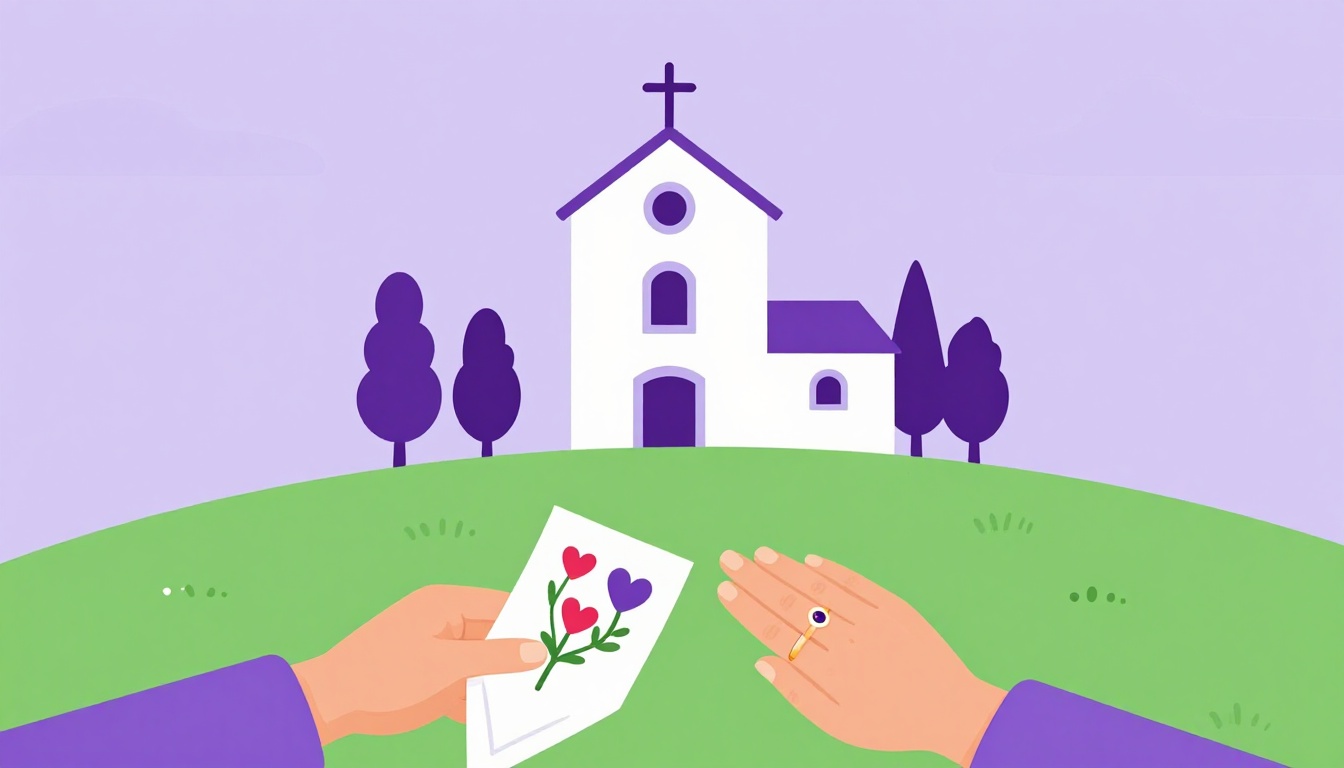
The lenço dos namorados
Here's one of the most charming Portuguese customs. The "lenço dos namorados" is an embroidered sweetheart's handkerchief from the Minho region in the north. The All About Portugal page on the lenço de namorados of Viana do Castelo traces its history. The tradition dates from the 17th and 18th centuries, according to the sources, and peaked between roughly 1850 and 1950. A young woman embroidered one for someone she loved, with little verses and symbols, and a boy wearing it in public signaled interest. The Aleaure article on the lenço dos namorados mentions towns like Viana do Castelo, Guimarães, Vila Verde, Telões, and Aboim da Nóbrega.
Some brides include a lenço in traditional dress. It isn't a required part of a wedding, but it's a lovely piece of the culture, and if you're planning a trip north it's worth a look.
Money dance, cortejo, and folk dances
At many Portuguese weddings, Remitly describes a money dance or shoe dance, where guests pay to dance with the bride or groom. There's also a "cortejo," a procession of cars with horns blaring after the ceremony. And the folk dances show up. The Wikipedia article on the vira describes it as a folk dance from northern Portugal, and the Wikipedia article on the corridinho links it to the Algarve in the south. So a wedding in the north leans vira, and one in the Algarve leans corridinho.
Party until "madrugada"
The party runs late. "Madrugada" means the early hours before dawn, and Portuguese weddings often reach it. Food is a big part of the night. Remitly mentions seafood and "leitão" (roast suckling pig), along with wine. If that sounds good, the menu words in our Portuguese food guide are already in your pocket, and a beer vocabulary post helps you order a cold one between dances.
| Portuguese | English |
|---|---|
| a missa de casamento | wedding Mass |
| o bolo de noiva | traditional wedding cake |
| o lenço dos namorados | embroidered sweetheart's handkerchief |
| o cortejo | procession, motorcade |
| o vira | folk dance of the north |
| o corridinho | folk dance of the Algarve |
| a madrugada | the small hours of the morning |
| o leitão | roast suckling pig |
| o marisco | seafood |
Being a Wedding Guest: Portuguese Phrases That Save You
You've been invited. Great. Here are the phrases that get you through the day, from the moment you say yes to the moment you say goodbye.
| Situation | Portuguese | English |
|---|---|---|
| RSVP | Confirmo a minha presença. | I confirm my attendance. |
| Congratulating | Estou muito feliz por vocês. | I'm so happy for you. |
| Meeting family | Muito prazer! Sou amigo do noivo. | Nice to meet you! I'm a friend of the groom. |
| Meeting family | Sou colega da noiva. | I'm a colleague of the bride. |
| Restroom (Brazil) | Onde fica o banheiro? | Where's the restroom? |
| Restroom (Portugal) | Onde fica a casa de banho? | Where's the restroom? |
| Dress code | Qual é o traje? | What's the dress code? |
| Gifts | Onde está a lista de presentes? | Where's the gift list? |
| Dancing | Vamos dançar? | Shall we dance? |
| Thanks | Obrigado pelo convite! | Thanks for the invitation! |
| Goodbye | Foi uma festa linda. Até breve! | It was a lovely party. See you soon! |
The Portuguese Learn page on wedding guest conversation has more small talk lines for a guest.
Say thanks, and say it properly
You'll say "thank you" more times than you count. How to say thank you in Portuguese covers "obrigado" and "obrigada" and when to use each, which matters when a relative hands you a plate at nine at night. If you need to squeeze past someone on the dance floor, excuse me in Portuguese has the right phrase, and it changes a little depending on whether you're asking for room or apologizing.
Small talk that works
At weddings, you'll be asked the same things again and again. Keep your answers short. Start with "tudo bem?" and the follow-ups from how are you in Portuguese. People will ask how you know the couple, so know how to say "sou amigo do noivo" or "sou amiga da noiva." The vocabulary in friend in Portuguese covers the word, and since Brazil has many ways to say it, that post is worth a read before the event.
When the night ends, say goodbye properly. Goodbye in Portuguese has options from "tchau" to "até logo," and at a wedding you'll say each one a dozen times as you work through the room.
Gifts and dress code
Most couples have a "lista de presentes." Brazilian couples often use one. In Portugal, giving money in an envelope is common, and you'll often see it given to the couple directly. Both are fine, and you can always ask, "Eles têm uma lista de presentes?"
For dress, the invitation may say "traje social" (formal wear) in Brazil. Dark suits are common, and guests usually avoid white, since white belongs to the bride. If you're packing an outfit, black in Portuguese is a handy word for the classic dark look. Read the invitation, ask someone close to the couple, and when in doubt, dress a little up.
Wedding Anniversaries
Weddings don't end with the party. Portuguese names anniversaries after materials, like English does, and "bodas" is the word.
The Cambridge entry for silver wedding anniversary gives "bodas de prata" for 25 years, and the Cambridge entry for golden wedding anniversary gives "bodas de ouro" for 50. There's also "bodas de diamante" for 60 in the usual Brazilian list. The Wiktionary entry on bodas de prata confirms the silver one.
| Years | Portuguese | English |
|---|---|---|
| 1 | bodas de papel | paper |
| 5 | bodas de madeira | wood |
| 15 | bodas de cristal | crystal |
| 20 | bodas de porcelana | porcelain |
| 25 | bodas de prata | silver |
| 30 | bodas de pérola | pearl |
| 50 | bodas de ouro | gold |
| 60 | bodas de diamante | diamond |
Lists vary a little by country and by source, so take this as a common Brazilian set, not a law. If someone in Portugal names a different year for a material, they may be using a slightly different list.
Talking about dates and years
You'll want to say how long a couple has been married, and that uses numbers. "Eles estão casados há vinte e cinco anos" means "They've been married for twenty-five years." It's the same "há" you use in "Estou casado há dez anos." If you need to say the wedding date, "Nos casamos no dia 12 de outubro" works, and the number and month words from earlier give you the parts.
Common Mistakes English Speakers Make
Here's a quick table of the slips that show up most, so you can skip them.
| Mistake | Fix | Why |
|---|---|---|
| "casar a" Ana | "casar com" a Ana | You marry someone with "com," never with "a." |
| Using "noiva" only as "bride" | Read "noiva" as bride or fiancée | The same word covers both before and on the wedding day. |
| "Eu sou casando" | "Vou casar" or "Estou me casando" | "Ser" plus an "-ando" form doesn't work for a future wedding. |
| Mixing "casa" and "casar" | "casa" is house, "casar" is to marry | They look alike, but they're different words. |
| "Felicidades!" as your only line | "Parabéns!" | "Felicidades" is a wish for happiness, and "parabéns" is congratulations. |
| Mixing Brazil and Portugal words | Pick one set and stay with it | "Terno" and "fato" both mean suit, but each belongs to one country. |
A few of these deserve a longer word.
The "casa" and "casar" trap is fun because the two are close. "Casa" means house, and you can read more in house in Portuguese. "Casar" means to marry. And to make it truly confusing, "casa" is also the present tense of "casar" for "ele" or "ela." So "Ela casa em maio" means "She's getting married in May," and "Ela está em casa" means "She's at home." One letter, two ideas. Context saves you.
The "felicidades" trap comes from Spanish. Spanish speakers use "felicidades" as a way to congratulate someone. In Portuguese, "felicidades" is a nice wish, as in "Muitas felicidades ao casal," but "parabéns" is the word for "congratulations." The full breakdown lives in our guide to saying "parabéns" for every occasion.
And the last mistake, mixing Brazil and Portugal, isn't really a mistake. People understand you. It just sounds a little odd, like saying "boot" and "trunk" in the same sentence. Pick a country, learn its set, and switch when you travel.
Practice Saying It Out Loud
You've got the words. Now comes the part that trips people up. You can read "Que o amor de vocês dure para sempre" a hundred times and still lock up when a real person is waiting for you to say it.
That's why we built Comigo around speaking first. You talk out loud with Capy the capybara, and you get word by word feedback on how you sound. Capy never judges, so you can practice a toast or a set of wedding wishes in private, mess it up, and try again before you say it to the couple. Silent studying gives you recognition. Speaking gives you the sentence when you need it.
If you're wondering how much effort this takes, is Portuguese hard to learn gives you an honest answer. If you're on a budget, how to learn Portuguese for free lists real options. If you're comparing tools, language learning apps for Portuguese walks through what to look for. And if you're heading to a wedding in Brazil, learn Brazilian Portuguese in Brazil covers how to make the most of the trip.
Here's a small drill. Pick three lines from the toast and vow tables. Say each one five times, slowly. Then say all three in a row at normal speed. Record yourself if you can, and listen back. Doing this in your kitchen is a lot cheaper than doing it in front of two hundred guests.
Wedding in Portuguese: Quick Answers
Is casamento wedding or marriage?
Both. "Casamento" covers the wedding day and the marriage that follows, and context tells you which one is meant. The Wiktionary entry for casamento lists both senses. If you need to be precise, say "a cerimônia" or "a festa de casamento" for the event.
How do you say "Will you marry me?" in Portuguese?
"Você quer casar comigo?" is the standard way. In Portugal, if you're speaking to someone close, you may hear "Queres casar comigo?" The answer is "Sim, eu aceito!" or just "Aceito!" Notice "comigo," which means "with me."
How do you say bride and groom in Portuguese?
"Noiva" is bride and "noivo" is groom, and together they're "os noivos." The Linguee page for bride and groom shows the pair in real sentences. Remember that both words also mean fiancée and fiancé before the wedding.
How do you say "I do" in Portuguese?
There's no exact match. People say "Aceito" (I accept), and in Brazil "Sim, eu aceito" is very common. It's short, so say it clearly and with confidence.
How do you say wedding cake, wedding ring, and honeymoon?
Wedding cake is "bolo de casamento" in Brazil and "bolo de noiva" in Portugal. Wedding ring is "aliança," and the plural "alianças" is what couples exchange. Honeymoon is "lua de mel" in both countries.
What is a padrinho?
A "padrinho" is a male sponsor, as in godfather, and at a wedding it's an honored friend or relative who stands with the couple. The feminine is "madrinha." In Brazil they often sign the marriage papers as witnesses. The number of padrinhos and madrinhas varies by family.
What is a bem-casado?
A "bem-casado" is a small Brazilian wedding sweet made of two thin sponge layers with a "doce de leite" filling, wrapped and given to guests. The name means "well-married," and the idea is luck for the couple. You'll see them on party tables and in favor bags.
Is same-sex marriage legal in Brazil?
Yes. It became legal on 16 May 2013 after a National Council of Justice ruling, which obliges notaries to perform civil marriages between same-sex couples, according to the Wikipedia article on the topic. Same-sex couples use the same words: "casamento," "noivos," "casar."
What's the difference between Brazilian and Portuguese wedding vocabulary?
Most of it is the same. The differences are small but real: "buquê" vs "ramo de noiva" for the bouquet, "terno" vs "fato" for the suit, "cerimônia" vs "cerimónia" for the ceremony, and "cartório" vs "conservatória" for the registry office. Brazilian and Portuguese speakers understand each other, so don't panic if you mix them.
Ready to Say It
Now you know the word, the people, the phrases, and the customs. What's left is saying them. Open Comigo, pick a line from this guide, and say it out loud to Capy until "casamento" feels like your own word. Then go to that wedding and say "Parabéns pelo casamento!" like you mean it.
Related guides
- How much does Rosetta Stone cost?Rosetta Stone pricing explained: plans, lifetime deals and what you actually get.
- italki reviewAn honest italki review: how lessons work, tutor quality, pricing and the downsides.
- Is Rosetta Stone worth it?Is Rosetta Stone worth the money in 2026? What it does well, and where it falls short.
- BoldVoice vs ELSA SpeakBoldVoice vs ELSA Speak: accent coaching, feedback quality, price and which to pick.