

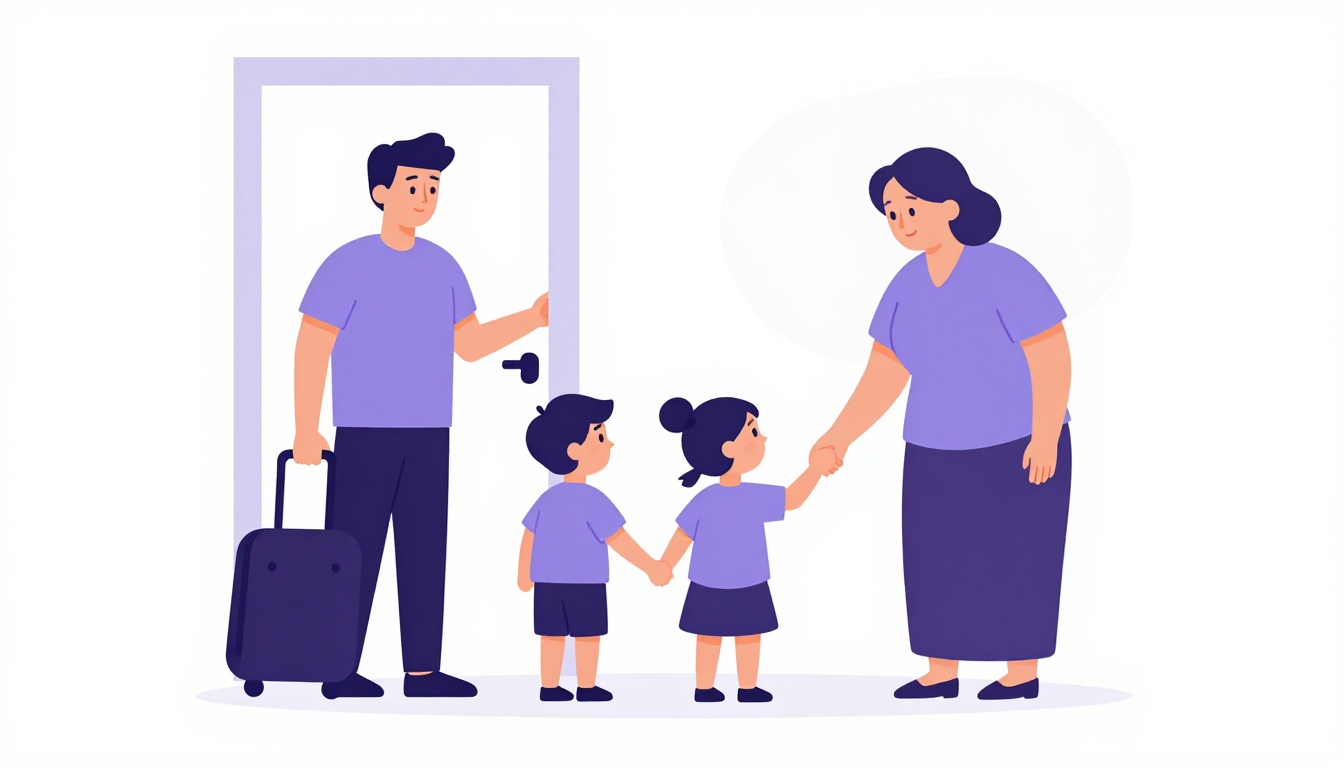
You're standing in the doorway of an apartment in Rio de Janeiro, coat half on, and your friend's mother is saying something warm and rapid-fire that ends in a word you don't recognize. You freeze. Do you say "tchau"? Is that too casual for someone's mom? Should you say something else entirely? You settle for an awkward wave and a mumbled sound that isn't really a word in any language, and you leave feeling like you missed something.
That moment happens to almost every English speaker learning Portuguese, and it usually happens more than once. Maybe yours wasn't a doorway in Rio. Maybe it was a video call with a friend in Lisbon that ended in silence because you didn't know how to wrap it up, or a work email in Portuguese you didn't know how to sign off. Goodbyes feel small until you're standing inside one with nothing to say.
Here's the good news: Portuguese goodbyes are not actually complicated once you see them laid out. There are really only a handful of core words, and each one tells you something about how close you are to the person, how formal the moment is, and whether you're in Brazil or Portugal. By the end of this guide you'll know every register, from the word you'll use fifty times a day to the one you should almost never use in Brazil unless you mean it, plus how the same words shift once you leave Brazil and Portugal for the wider Portuguese-speaking world.
The quick answer: every way to say goodbye in Portuguese
If you only have thirty seconds, here's your cheat sheet. Every phrase below is real, current, and used by native speakers today, drawn from usage notes at Practice Portuguese and confirmed across Babbel's overview of Portuguese goodbyes.
| Phrase | Literal meaning | Register | Where it's used | Best for |
|---|---|---|---|---|
| Tchau | (from Italian "ciao") | Casual to neutral | Brazil and Portugal | Almost any goodbye, friends, family, coworkers |
| Adeus | "To God" | Formal in Brazil, everyday in Portugal | Both, very different meaning | Portugal: any goodbye. Brazil: only final, dramatic partings |
| Até logo | "Until later" | Neutral | Both | General "see you later," same day or soon |
| Até já | "Until right now" | Neutral, warm | Both | Seeing someone again in minutes |
| Até amanhã | "Until tomorrow" | Neutral | Both | You'll see them again tomorrow |
| Até mais | "Until more" | Casual | Mostly Brazil | Everyday "see you around" |
| Falou | "Spoken" | Very casual, slang | Brazil, mostly young speakers | Close friends only |
| Valeu | "It was worth it" | Very casual, slang | Brazil | Casual thanks + goodbye combo |
| Fui | "I went" | Very casual, slang | Brazil | "I'm outta here," leaving abruptly |
| Vai com Deus | "Go with God" | Warm, blessing | Mostly Brazil | Said to the person leaving |
| Boa noite | "Good night" | Neutral | Both | Evening goodbye, doubles as a greeting |
Keep this table bookmarked, but don't stop reading here. The real value in learning Portuguese goodbyes isn't memorizing the list, it's understanding which one fits which moment, and that's where most guides stop short. This one won't. And if you want to actually get comfortable saying these out loud instead of just recognizing them on a page, you can practice saying them out loud with real conversation practice, which is a very different skill than reading a list silently.
"Tchau": the word you'll use most
Say it with me: "tchau." It rhymes with "how," but it starts with a soft "ch" sound, like the beginning of "cheese." In IPA it's written [ˈtʃaw], a pattern you can cross-check against the broader Wikipedia guide to Portuguese IPA, and you can hear real native speakers say it in context on YouGlish's Portuguese pronunciation search for "tchau", which is worth a listen before you try it yourself. It's one syllable, and the pitch tends to fall at the end, a little like you're letting the word drop as you turn to leave.
"Tchau" isn't originally a Portuguese word at all. It came from the Italian "ciao," which arrived in Brazil and Portugal through Italian immigration and, later, sheer popularity, according to Migaku's breakdown of goodbye phrases in Portuguese. Italian "ciao" itself has a much older, humbler history than most people realize: it grew out of a Venetian phrase meaning something like "I am your servant," a marker of goodwill between speakers, which is a detail the Wikipedia entry on "ciao" traces back through Italian dialects before the word spread across Europe and eventually into Portuguese as a farewell. It's a strange, nice bit of trivia: the most common goodbye in two entire countries started life as a small, humble greeting between strangers in Venice.
In Portuguese, "tchau" is goodbye and only goodbye, unlike Italian, where "ciao" still covers both hello and goodbye. You won't hear "tchau" used as a greeting in Brazil or Portugal. Portuguese narrowed the borrowed word down to a single job and gave it a spelling that matches Portuguese phonetics rather than Italian ones, which is why it's spelled with "tch" instead of "ci."
What makes "tchau" so useful is how far it stretches. You can say it to your best friend, your grandmother, your boss, or a stranger who just gave you directions. It sits comfortably in almost every social situation, which is rare for a single word in any language. Compare that to English, where "goodbye" can sound stiff, "bye" can sound too casual for a job interview, and "see ya" can sound too familiar for your landlord. "Tchau" mostly avoids that problem.
Brazilians and Portuguese speakers also love to double it up: "Tchau, tchau!" This isn't a mistake or a stutter. Doubling the word makes it warmer, friendlier, almost sing-song, the kind of thing you say to a child, a close friend, or someone you genuinely enjoy talking to. There's an even softer version aimed squarely at children and pets: "tchauzinho," built from "tchau" plus the diminutive ending "-zinho" that Portuguese uses constantly to make words sound smaller, cuter, or more affectionate. You'll hear parents teach toddlers to wave and say "tchauzinho" long before the child can manage a full sentence, and grown adults still use it playfully with each other, the same way an English speaker might say "byeee" with extra vowels. Wiktionary's entry for "tchauzinho" confirms it as a standard diminutive form, and the broader pattern of shrinking words down with "-inho" or "-zinho" endings is covered in Wikipedia's general article on the diminutive as a grammatical feature that Portuguese leans on far more heavily than English does.
One question that comes up constantly in forums and comment sections: is "tchau" only a Brazilian thing? No. It's just as common in Portugal, though European Portuguese speakers lean slightly more on "adeus" in day-to-day life than Brazilians do, a distinction the Practice Portuguese notes on saying goodbye in European Portuguese lay out clearly. Both countries use "tchau" constantly. It's the safest word in this entire guide, and if you remember nothing else, remember this one.

"Adeus": the word that means two different things depending on where you are
This is the single most interesting fact in the whole topic, so let's give it the room it deserves.
"Adeus" is a cognate of the French "adieu," and it means, literally, "to God," a translation you can confirm through Wiktionary's entry for "adeus". That origin tells you something important: this word was built for goodbyes that carry weight, goodbyes where you're commending someone to God's care because you genuinely don't know when, or if, you'll see them again. That old, heavy meaning still shapes how the word feels today, but it plays out completely differently on either side of the Atlantic.
In Brazil, "adeus" is not a casual goodbye. Say it to a coworker as you head out for lunch and you'll get a strange look, maybe even a worried one. Brazilians reserve "adeus" for real finality: the end of a relationship, someone moving away for good, a goodbye at a deathbed, a dramatic breakup scene in a telenovela. Using it lightly can come across as overly dramatic or even a little ominous, like you're implying you never want to see the person again. A discussion thread on the Practice Portuguese forum about "adeus" versus "tchau" has native speakers confirming exactly this: Brazilians will sometimes joke about it, saying "adeus" dramatically just to be funny, precisely because everyone knows it's not the normal word.
It helps to think about why the weight is there at all. Brazil is a huge country, and for a lot of its history, distances that seem ordinary now, a move from a small town to São Paulo, a family split between the northeast and the south, really did mean people might not see each other again for years, sometimes ever. A word that means "to God" fits that kind of parting. It doesn't fit a coworker stepping out for coffee, which is exactly why using "adeus" casually can land strangely, almost like you're accidentally applying the emotional weight of a permanent farewell to a completely ordinary moment. Portuguese speakers pick up on that mismatch instantly, even if they couldn't necessarily explain the history behind it.
In Portugal, none of that heaviness applies. "Adeus" is just the standard goodbye. You'll hear a cashier say it to you at the supermarket. You'll hear it at the end of a phone call with your dentist. It's a touch more formal than "tchau," but only a touch, roughly the difference between "goodbye" and "bye" in English rather than anything close to "farewell forever." The Practice Portuguese comparison of European and Brazilian Portuguese points out that this kind of everyday vocabulary split is one of the most noticeable differences between the two varieties of the language, right up there with pronunciation, and Wikipedia's separate articles on Brazilian Portuguese and European Portuguese both note that vocabulary divergence between the two, not just accent, is one of the clearer markers of which variety a speaker grew up with.
Here's the split laid out side by side:
| Brazil | Portugal | |
|---|---|---|
| How common is "adeus" in daily speech? | Rare | Very common |
| What it implies | Real finality, a long time apart, or forever | Nothing special, just a polite goodbye |
| Tone | Dramatic, heavy, sometimes even alarming | Neutral, slightly formal |
| Safe to say to a cashier or coworker? | No, sounds strange | Yes, totally normal |
| Everyday equivalent instead | "Tchau" | "Adeus" itself, or "tchau" |
If you take one thing from this entire post, take this: in Brazil, default to "tchau." Save "adeus" for moments that actually feel final. In Portugal, "adeus" is safe almost anywhere, and you don't need to overthink it. Mixing these up is the single most common mistake English speakers make with Portuguese goodbyes, and we'll come back to that in the mistakes section below.
The "até" family: your safest all-purpose goodbyes
"Até" means "until," and it's the backbone of an entire family of goodbyes that work well in almost any situation, formal or casual, Brazil or Portugal. Think of them as the Portuguese equivalent of "see you," "see you soon," "see you tomorrow." Each one just swaps out the time word at the end. Migaku's dedicated breakdown of the "até" family is a good reference if you want to go deeper on this specific group of phrases.
| Phrase | Literal meaning | Timeframe implied | Typical use |
|---|---|---|---|
| Até logo | Until later | Later today, or "soon" in general | The safest all-purpose "see you later" |
| Até já | Until right now | Minutes from now | You're stepping away briefly, coming right back |
| Até amanhã | Until tomorrow | Next day | Leaving work, ending a class, a nightly goodbye |
| Até mais | Until more | Sometime, unspecified | Very common in Brazil, casual "see you around" |
| Até breve | Until soon | Soon, but less specific than "até já" | A bit more formal, common in Portugal |
"Até logo" is probably the single most versatile phrase on this whole page after "tchau." It works in a meeting, at a family dinner, or texting a friend, and it doesn't commit you to any specific timeframe the way "até amanhã" does. If you're not sure which "até" phrase to use, "até logo" is almost always a safe bet.
"Até mais" deserves a note of its own because it shows up constantly in Brazilian daily life, at the end of texts, in casual chats, tossed off as people walk away from each other. It's a little more relaxed than "até logo," roughly the difference between "see you later" and "see you around." In Portugal, people lean a bit more on "até logo" and use "até mais" less often, which is one of those small dialect habits that native speakers pick up on immediately even if they can't explain why.
There's a nice logic hiding in this whole family once you notice it: Portuguese doesn't really have one word for "see you," it builds the goodbye out of the actual time you expect to see the person again. That's a pretty different way of thinking about farewells than English uses, and once it clicks, you'll start noticing it everywhere, in text messages, at the end of phone calls, in the last line of an email.
Learning to recognize these phrases on a page is one thing. Actually producing them at conversational speed, with the right rhythm and the right word chosen without hesitating, is a different skill entirely, and it's one you build by talking, not by reading. That's the gap Comigo is built to close: instead of tapping through flashcards in silence, you say the phrase out loud, in a real exchange, until it stops feeling like a translation exercise and starts feeling like your own voice. If you want to try that with this exact list of phrases, you can start speaking Portuguese today.

Casual slang goodbyes: strictly for friends
Every language has a layer of slang that sounds great among friends and painfully out of place anywhere else. Portuguese, especially Brazilian Portuguese, has a rich one for goodbyes. Use these with your close friends, your peer group, people your own age you already have an easy relationship with. Do not use these with your boss, your partner's parents, or anyone you're meeting for the first time. Both Portuguese with Carla's list of casual ways to say bye and Fluent in 3 Months's rundown of fifteen ways to say goodbye are good places to hear more slang like this in context.
| Phrase | Literal meaning | What it actually means | Register warning |
|---|---|---|---|
| Falou | "Spoken" | "See ya," "peace" | Friends only, mostly younger speakers |
| Valeu | "It was worth it" | A combined "thanks, bye" | Friends and casual acquaintances |
| Fui | "I went" / "I'm gone" | "I'm outta here" | Very informal, can sound abrupt |
| Vou nessa | Short for "vou nessa onda" | "I'm heading off," "I'm out" | Friends only, very Brazilian |
| A gente se vê | "We'll see each other" | "See you around" | Casual, friendly, no fixed plan implied |
"Falou" is worth an extra sentence because it trips people up. It's literally the past tense of "falar," to speak, so it looks like it should mean "he/she spoke," a meaning you can confirm in Wiktionary's entry for "falou". In practice, used as a goodbye, it functions almost exactly like the English "later" tossed over your shoulder as you walk out the door. You'll hear it constantly among younger Brazilians, on social media, in group chats, at the end of casual calls between friends.
"Fui" is the bluntest of the bunch. It literally means "I went," using the past tense to describe something that's happening right now, which is a quirk of casual spoken Portuguese rather than a grammar mistake. Saying "Fui!" as you leave a party is the equivalent of saying "I'm gone!" in English, a little abrupt, a little playful, definitely not something you'd say leaving a job interview.
"A gente se vê" is friendlier and softer than the others on this list. It doesn't promise anything specific, no set time, no set place, just a warm acknowledgment that you'll cross paths again. If you're building your first vocabulary of casual Portuguese phrases, it's a good one to have alongside basics like knowing how are you in Portuguese, since the two tend to bookend the same easygoing conversations with friends.
One more warning worth repeating: mixing up register is one of the fastest ways to sound like you learned Portuguese from a textbook rather than from real people. Using "Fui" with your professor, or "adeus" with your best friend in Rio, both land oddly, just in opposite directions. Pay attention to who you're talking to before you pick your goodbye.
Blessing-style goodbyes: "vai com Deus" and "fica com Deus"
There's a whole other category of Portuguese goodbye that isn't about register so much as warmth and care, and it comes up especially often with older speakers or in religious households, particularly in Brazil.
"Vai com Deus" means "go with God." It's said to the person who is leaving, a small blessing wishing them safe travels and protection on their way. You'll hear it from a grandmother sending a grandchild off on a trip, or between family members after a visit, and you can hear it broken down with example audio on Speak Like a Brazilian's entry for "vai com Deus".
Its mirror image is "fica com Deus," which means "stay with God." This one flips the direction: it's said by the person who is leaving to the person who is staying behind, blessing them and, in a way, blessing the place they're staying in. It's a lovely bit of symmetry once you notice it. The person going gets "vai" (go), the person staying gets "fica" (stay), and God travels with both of them either way. You can find the same pair explained with regional notes at Speak Like a Brazilian's entry for "vá com Deus", which covers a slightly different verb conjugation of the same idea.
These phrases aren't neutral, everyday goodbyes the way "tchau" is. You wouldn't say "vai com Deus" to a coworker as they head to the printer. But you will hear them, especially in Brazil, at family gatherings, when someone is heading out on a long trip, or in more religious or older-generation households where faith is woven naturally into daily language. Recognizing them, and understanding the direction each one flows, is exactly the kind of nuance that makes you sound like you actually understand Portuguese culture rather than just its vocabulary list. It's a similar warmth to phrases like I love you in Portuguese, another expression Brazilians and Portuguese speakers use more openly and more often between family members than English speakers typically do.
Formal and professional goodbyes
Portuguese, like English, has a separate register entirely for business and written correspondence, and it's worth knowing the difference between what you write and what you say out loud in a professional setting, because they're not the same thing.
| Context | Phrase | Meaning | Notes |
|---|---|---|---|
| Written, formal email | Atenciosamente | Roughly "sincerely" or "best regards" | The standard formal email sign-off |
| Written, very formal | Com os melhores cumprimentos | "With the best regards" | More formal than "atenciosamente," used in stiffer correspondence |
| Spoken, Portugal | Adeus | "Goodbye" | Fully normal in professional settings, no drama attached |
| Spoken, Brazil, first meeting | Até logo / Tchau | "See you later" / "Bye" | Brazilians often stay professional in writing but relax to "tchau" once rapport is built |
| Spoken, Brazil, after rapport | Tchau, Até mais | "Bye," "See you around" | Common with colleagues you know well |
Written Portuguese business correspondence tends to be noticeably more formal than spoken conversation, a gap that Tandem's guide to writing an email in Portuguese explains well if you're sending professional emails and want the closing line to land correctly. "Atenciosamente" is your safe default for almost any formal email, similar in weight to "sincerely" or "kind regards" in English.
Spoken professional goodbyes work differently, and this is where the Brazil versus Portugal split shows up again. In Portugal, ending a business call or meeting with "adeus" is completely unremarkable, exactly what you'd expect from the earlier section on how normal that word is there. In Brazil, professional spoken goodbyes usually stay a notch below "adeus": a polite "até logo" works well with someone you've just met, and once you've built rapport with a colleague, it's completely normal to loosen up to a simple "tchau" or "até mais," even in a business context. Brazilian workplace culture tends to be warmer and less rigid than the written language might suggest, and the goodbye is usually where that warmth shows first.
"Boa noite": a goodbye hiding inside a greeting
Here's a quirk that catches a lot of English speakers off guard. "Boa noite" means "good night," a phrase you can look up directly in Wiktionary's entry for "boa noite", and you probably already know it as a greeting, something you'd say walking into a restaurant after dark or answering the phone in the evening. But in both Brazil and Portugal, "boa noite" does double duty as a goodbye too.
If you're leaving a friend's house at nine in the evening, "boa noite" works perfectly well as your parting line, functioning exactly the way "good night" does in English when you leave a party late. The difference is that Portuguese uses the same time-of-day greetings, "bom dia" for morning, "boa tarde" for afternoon, "boa noite" for evening and night, as both hellos and goodbyes depending on context, something the Wikipedia entry on the Portuguese language touches on as part of its broader look at everyday usage. Only "boa noite" really gets used as a farewell with any regularity, since it lines up naturally with the moment people tend to be parting ways, at the end of the day.
This trips learners up because the same three words can open a conversation or close one, and you have to rely on context, not the words themselves, to know which is happening. If someone opens the door and says "boa noite," they're greeting you. If someone says it as they're stepping through the door to leave, they're saying goodbye. It sounds obvious written down, but in the moment, especially early on, it can leave you hesitating over whether to respond with a "hello" or a "goodbye" back.
Goodbye across the Lusophone world
Everything so far has focused on Brazil and Portugal, because that's where the vast majority of Portuguese speakers live and where nearly all the learning material out there is aimed. But Portuguese is the official language of far more than two countries. It's also spoken in Angola, Mozambique, Cape Verde, Guinea-Bissau, São Tomé and Príncipe, and East Timor, all members of the Community of Portuguese Language Countries, a group Wikipedia's broader article on the Lusophone world describes as sharing Portuguese as an official or co-official language across four continents.
Because most of these nations, including Angola, Mozambique, Cape Verde, Guinea-Bissau, and São Tomé and Príncipe, were Portuguese colonies rather than Brazilian ones, their formal language norms generally sit closer to European Portuguese than to Brazilian Portuguese. In practice, that means "adeus" tends to carry less of the dramatic, final weight it has in Brazil and functions more like the everyday Portuguese usage described earlier, an ordinary, slightly formal goodbye rather than something reserved for tearful partings. East Timor, on the far side of the world in Southeast Asia, is a slightly different case again: Portuguese is an official language there alongside Tetum, a legacy of Portuguese colonial rule rather than Brazilian influence, as Wikipedia's article on East Timor notes.
That said, "tchau" hasn't stayed confined to Brazil and Portugal either. Brazilian television, especially telenovelas, has been exported across Lusophone Africa for decades, a pattern Wikipedia's article on the telenovela format touches on as part of its reach beyond Brazil's borders. That kind of cultural exposure is exactly the sort of channel through which casual, distinctly Brazilian vocabulary like "tchau" spreads into everyday speech far outside Brazil, even in places where the formal register of the language leans European. It's worth being cautious here and not overstating specifics that vary a lot by country, generation, and even individual family, but the general shape holds: expect European Portuguese norms as your starting assumption in Lusophone Africa and East Timor, and don't be surprised to hear "tchau" anyway, especially from younger speakers who grew up with Brazilian media.
Text and WhatsApp goodbyes
Typed goodbyes shrink even further than spoken ones, especially in the fast back-and-forth of a WhatsApp thread, which is still the dominant way friends and family message each other across the Portuguese-speaking world. A few abbreviations show up constantly enough that it's worth knowing them even if you never plan to use them yourself.
| Shorthand | Full word | Meaning | Tone |
|---|---|---|---|
| Bjs | Beijos | "Kisses" | Warm, affectionate sign-off between friends or family |
| Abs | Abraços | "Hugs" | Friendly, slightly more neutral than "bjs" |
| Flw | Falou | "See ya" | Casual, quick |
| Vlw | Valeu | "Thanks, bye" | Casual, quick |
"Bjs" is short for beijos, literally "kisses," and it's an extremely common way for Brazilians and Portuguese speakers to close out a friendly text, similar to how an English speaker might end a message to a close friend with "xo." "Abs," short for abraços, "hugs," carries a slightly more neutral, all-purpose warmth, closer to signing off with "take care" than anything romantic. Both can show up at the end of texts, emails between friends, and even fairly casual work messages once people know each other well.
"Flw" and "vlw" are just the spoken slang words "falou" and "valeu" from earlier in this guide, stripped down to consonants the way text speak strips words down in every language. This kind of vowel-dropping shorthand isn't unique to Portuguese: English texters do the same thing with "thx" for "thanks" or "msg" for "message," trimming a word down to its recognizable skeleton to save keystrokes, a broad pattern documented under the umbrella of internet slang. Don't use "flw" or "vlw" in anything formal, an email to a client would look as odd with "vlw" in it as an English business email would look with "thx" instead of "thank you," but among friends over text, they're completely normal, arguably more common than typing the full word out.
Saying goodbye to a group
Everything covered so far works for one person, but goodbyes shift slightly when you're addressing more than one person at once, and it's a small adjustment worth knowing.
The easiest fix is to tack on a group word after "tchau." "Tchau, pessoal" uses pessoal, which functions like "everyone" or "folks," and it works well in slightly more organized settings, wrapping up a work meeting, leaving a class, saying goodbye to a group of coworkers. "Tchau, gente" swaps in gente, literally "people," but used constantly in casual Brazilian Portuguese the way English speakers use "guys" or "everyone," and it leans more casual and more Brazilian than "pessoal" does.
Both phrases follow the same pattern: your regular goodbye word, plus a group noun tacked on the end. You can do the same thing with "até logo, pessoal" or "tchau, gente, até amanhã," stacking the group address with a time-based goodbye exactly the way you would with one person. It's a small detail, but showing up to a group hangout and saying a plain, unadorned "tchau" as you leave a table of six friends can come across as a little flat compared to a warmer "tchau, gente," which acknowledges the whole group rather than the room in general.
A few goodbyes in context
Vocabulary lists only get you so far. Here's what a few of these phrases actually sound like inside a real conversation.
Two friends wrapping up a hangout:
Marina: Já vou indo, tá tarde. (I'm heading out, it's getting late.)
Pedro: Ah, já? Tá bom. Falou, então! (Oh, already? Okay. See ya, then!)
Marina: Falou! Valeu pela noite. (See ya! Thanks for tonight.)
Pedro: A gente se vê. Tchau, tchau! (See you around. Bye, bye!)
A phone call between family members winding down:
Avó: Então tá, filha, cuida-te. (Alright then, sweetheart, take care.)
Filha: Tá bom, mãe. Beijo. Tchau. (Okay, mom. A kiss. Bye.)
Avó: Tchau, tchau, tchau, beijo, vai com Deus. (Bye, bye, bye, kiss, go with God.)
Filha: Tchau! (Bye!)
A workplace exchange at the end of a meeting:
Sr. Andrade: Muito obrigado pelo seu tempo hoje. (Thank you very much for your time today.)
Cliente: Eu que agradeço. Até logo. (Thank you. See you later.)
Sr. Andrade: Até logo. Qualquer coisa, me escreve. (See you later. If you need anything, write to me.)
Cliente: Combinado. Boa tarde! (Agreed. Good afternoon!)
Notice how the phone call keeps stacking "tchau" the way we described earlier, and how the family call reaches naturally for "vai com Deus" alongside a plain goodbye, while the workplace exchange never once drops into slang. That's the whole guide in miniature: the words don't change much, but which ones you reach for, and how many times you say them, depends entirely on who's on the other end.
Common mistakes English speakers make
A few patterns come up again and again with learners, and knowing about them ahead of time will save you some awkward moments.
Overusing "adeus" in Brazil. This is the big one. English speakers learn "adeus" first because it looks and sounds like the "official" word for goodbye, similar to how a textbook might present it. Then they use it constantly in Brazil, at the coffee shop, leaving a meeting, ending a casual chat, and get puzzled looks in return. Remember the split from earlier: in Brazil, save "adeus" for genuinely final goodbyes, and lean on "tchau" for everything else.
Forgetting the Brazil-Portugal split entirely. A lot of learning resources treat "Portuguese" as one flat thing, but goodbyes are one of the clearest places where Brazilian and European Portuguese genuinely diverge, not just in accent but in which word feels normal. If you're not sure which variety you're learning, it's worth checking, because the advice in this guide flips depending on which country you're speaking to.
Mispronouncing "tchau." English speakers often want to pronounce it like "chow" with a hard, flat "ow," or they soften the "ch" into an English "sh" or "j" sound. It's closer to the "ch" in "cheese" plus the vowel sound in "how." Spend two minutes scanning real clips on YouGlish's Portuguese pronunciation search for "tchau" and you'll fix this instantly, it's much easier to copy by ear than to reconstruct from a written description. The same trick works for "adeus" if you're unsure how it should sound in context, since YouGlish's search for "adeus" pulls up real speakers using it in the wild rather than an isolated recording.
Treating all the "até" phrases as interchangeable. They're close in meaning, but "até já" genuinely implies minutes, not hours, and "até amanhã" only makes sense if you're actually going to see the person again the next day. Using "até amanhã" when you won't see someone for a week reads oddly to a native ear, similar to saying "see you tomorrow" in English and then not showing up for a week.
Dropping "até" with no time word at all. "Até" on its own, standing alone at the end of a sentence with nothing after it, isn't really a complete goodbye in the way beginners sometimes assume. Native speakers do occasionally trail off with just "até..." as an informal, trailing-off kind of farewell, similar to an English speaker saying "well, until..." and letting the sentence hang, but it's not a solid, everyday substitute for "até logo" or "até mais." If you're not sure which time word to attach, default to "até logo" rather than leaving "até" bare.
Assuming "boa noite" is only ever a greeting. Learners often file "boa noite" away early as "how you say hello in the evening" and stop there, which means they miss it entirely when someone uses it to say goodbye instead. Since the same three words open and close a conversation depending on context, walking in versus walking out, it's worth actively listening for which one is happening rather than assuming.
Using slang in the wrong setting. "Falou," "valeu," and "fui" are fun, casual, and completely wrong for a job interview, a first meeting with someone's parents, or any formal correspondence. Save them for people you already know well.
How to respond when someone says goodbye to you
Responding to a Portuguese goodbye is usually simpler than choosing one yourself, because you can almost always mirror what the other person said. If someone says "tchau," saying "tchau" back is completely natural, and doubling it, "tchau, tchau," is a nice, friendly way to close the loop. If they say "até logo," you can either echo it back or answer with a related phrase, like "até já" if you genuinely expect to see them again shortly.
A few responses work well no matter what the other person opened with. "Tchau, cuida-te" (bye, take care) is warm and works in most casual settings. In Brazil, you'll often hear a simple "falou" or "valeu, tchau" tossed back between friends as a quick, easy close. In more formal exchanges, especially in Portugal, echoing "adeus" back is the safe, expected move, no need to overthink it or swap in something more casual. A more detailed look at how these back-and-forth exchanges typically unfold, including the small verbal cues Portuguese speakers use to signal a conversation is actually ending rather than just pausing, is covered in Elon's grammar notes on leave-taking in Brazilian Portuguese, which is a useful reference if you want the underlying pragmatics rather than just a list of phrases.
The real skill here isn't memorizing a response chart, it's getting comfortable enough with the core words that responding becomes automatic, the same way you don't consciously choose between "bye" and "see ya" in English, you just say whichever one fits the moment without thinking about it. That kind of automatic fluency only comes from actually using the words out loud, over and over, in real exchanges, not from reading them silently off a page like this one.

Practice tips: how to actually make these stick
Reading through a full list of ways to say goodbye is a fine first step, but it won't get "tchau" or "até logo" into your mouth at the speed a real conversation demands. A few things genuinely help close that gap.
Start narrow. Pick two or three phrases from this guide, "tchau" for casual situations and "até logo" for almost everything else, and use only those for a week. Trying to juggle every slang term and blessing phrase from day one is a good way to freeze up mid-sentence, which defeats the purpose. The same goes for other everyday basics: getting comfortable with a handful of core words, a simple yes in Portuguese, a warm "how are you," and a solid goodbye, will carry you through far more real conversations than a huge vocabulary list you half remember.
Say them out loud, always. Silent recognition, being able to read "tchau" and know it means goodbye, is a completely different skill from production, being able to say it correctly and confidently in the middle of a live conversation. Your mouth needs the repetition just as much as your brain needs the vocabulary. This is really the heart of why speak-first practice matters so much for a topic like this one: goodbyes are inherently spoken, they happen in real time, at the end of a real exchange, and no amount of silent flashcard review prepares you for that split-second moment when you need to pick the right word and say it out loud without hesitating.
Pay attention to who's in the room. Before you speak, run a quick mental check: is this a close friend, a coworker, a stranger, an older family member? That single question will steer you toward the right register almost every time, whether that's a casual "falou" or a respectful "até logo."
Listen for real examples. Brazilian shows, Portuguese podcasts, and phone call scenes in film are full of natural goodbyes, including that cascading "tchau, tchau, tchau" phone habit we covered earlier. The more you hear it in context, the more natural it'll feel coming out of your own mouth.
If you want a place to actually practice saying these phrases out loud with a real back-and-forth, rather than just testing your memory of a list, that's exactly the gap Comigo was built to close. It's a speak-first way to learn Portuguese: you talk, you play, you practice with real exchanges instead of tapping silently through multiple choice questions. You can try it out and start speaking Portuguese today.
Back to that doorway
So, that scene in Rio, the coat half on, the friend's mother saying something warm you couldn't quite catch. Here's what you'd say now: a warm "tchau, tchau," maybe followed by "até logo" if you know you'll see her again soon, or "boa noite" if it's already dark outside. Not "adeus," unless you're genuinely leaving the country for good, and not some awkward wave standing in for a word you don't have yet.
That's the real value in learning a handful of goodbyes properly instead of memorizing a long list you half remember. You stop freezing in doorways. You stop guessing. You know exactly which word fits the moment, whether you're in Rio or Lisbon, on a video call, closing out a work email, or even further out, in Luanda or Praia where the same words carry a slightly different weight. And once you've got the words, the only thing left is saying them enough times that they stop feeling foreign and start feeling like yours, which is a lot easier to do out loud, with another person, than silently on a page. Whenever you're ready to give that a try, Comigo is right there waiting.
Related guides
- Rosetta Stone vs BabbelRosetta Stone vs Babbel: price, method and which one to pick.
- italki reviewAn honest italki review: how lessons work, tutor quality, pricing and the downsides.
- Is Rosetta Stone worth it?Is Rosetta Stone worth the money in 2026? What it does well, and where it falls short.
- How much does Rosetta Stone cost?Rosetta Stone pricing explained: plans, lifetime deals and what you actually get.


