

Your phone buzzes on a Sunday morning. It is a video call from your partner's mother in São Paulo, and behind her you can see a photo on the wall of a smiling older woman holding a baby. "Essa é a vovó," she says, tapping the frame. You nod like you understood every word, but inside you are doing quick math. Vovó. Is that the same as "avó," the word you learned from an app three weeks ago? Is it a nickname? Did you already meet this person, or is this someone new?
If you are learning Portuguese because of a Brazilian partner, in-laws, or a family trip you are planning, you will run into this exact moment sooner or later. "Grandma" in Portuguese is not one tidy word you can memorize and move on from. It is a small cluster of related words, each one carrying its own level of warmth, formality, and region. Get the wrong one at the wrong moment and you will not cause offense, but you might sound like you are reading from a dictionary instead of talking to a person. This guide walks through every version you will actually hear, when to use which one, how to pronounce the tricky parts, and where the words come from. If you want to practice saying them out loud instead of just reading them silently, that is exactly the kind of drill you can run at app.usecomigo.com, since a word like this only really sticks once your mouth has said it a few dozen times.
Quick answer: every way to say grandma in Portuguese
Here is the short version before we slow down and go word by word. Bookmark this table if you only need a fast answer.
| Word | Pronunciation | Register | When to use it |
|---|---|---|---|
| avó | ah-VAW | Neutral, formal | Dictionaries, forms, writing, talking about a grandmother in the third person |
| vovó | voh-VAW | Warm, everyday | What most Brazilian families actually call grandma |
| vó | VAW | Casual, affectionate | Shortened version, common in speech and texting |
| vozinha / voinha | voh-ZEE-nya / voh-EE-nya | Very affectionate, regional | Northeast Brazil, also a nickname of endearment |
| bisavó | bee-zah-VAW | Neutral to warm | Great-grandmother |
That table alone answers the search query, but it also raises new questions. Why are there five words for the same person? Which one is "correct"? A source like Cambridge Dictionary's Portuguese entry for grandmother will give you "avó" and stop there, which is technically accurate and practically incomplete. Real families do not talk like dictionaries. Let's go through each word properly.

Avó: the formal, dictionary-correct word
"Avó" is the word you will find in a Portuguese textbook, on a government form, or in a news article that mentions someone's grandmother. It comes with a feminine article, "a avó," and its plural is "as avós." If you are describing your partner's family to a coworker in Portuguese, "a avó dele mora no Rio" ("his grandmother lives in Rio") is completely correct and sounds natural in that context.
The tricky part is the vowel. "Avó" is pronounced with an open "o," closer to the "aw" in the English word "saw." Say it like "ah-VAW," with the stress landing hard on the second syllable. Wiktionary's entry for avó marks this open vowel clearly, and it matters, because the near-identical word "avô" (grandfather) uses a closed "o" instead. We will come back to that trap in a few sections, since it is the single most common pronunciation mistake English speakers make with this word family.
Where you will actually hear "avó" spoken out loud: news broadcasts, formal introductions ("esta é a minha avó," this is my grandmother), and any situation where someone is being polite or a little distant. A stranger asking about your family, a teacher, a doctor's intake form. It is correct everywhere, but it is not usually what a five-year-old yells across a kitchen.
Vovó: the word families actually use
Here is the word you will hear far more often in real Brazilian homes: "vovó." It is what almost every Brazilian kid calls their grandmother, and adults keep using it for the rest of their lives, the same way an English speaker never fully graduates from "grandma" to "grandmother" in casual conversation.
"Vovó" is a reduplicated form, meaning it repeats a syllable, the same pattern you see in baby words across many languages, like "mama" or "dada" in English. A breakdown from Prof. Mara on Brazilian Portuguese family words explains this reduplication pattern for the parallel word "vovô" (grandpa), and the logic carries straight over to "vovó." Small children find repeated syllables easier to produce, so the family adapts the "formal" word into something a toddler's mouth can actually manage, and then everyone keeps using it because it sounds warm.
You will hear things like:
- "Vovó, olha o que eu fiz!" (Grandma, look what I made!)
- "A vovó chegou!" (Grandma is here!)
- "Vou dormir na casa da vovó." (I'm going to sleep at grandma's house.)
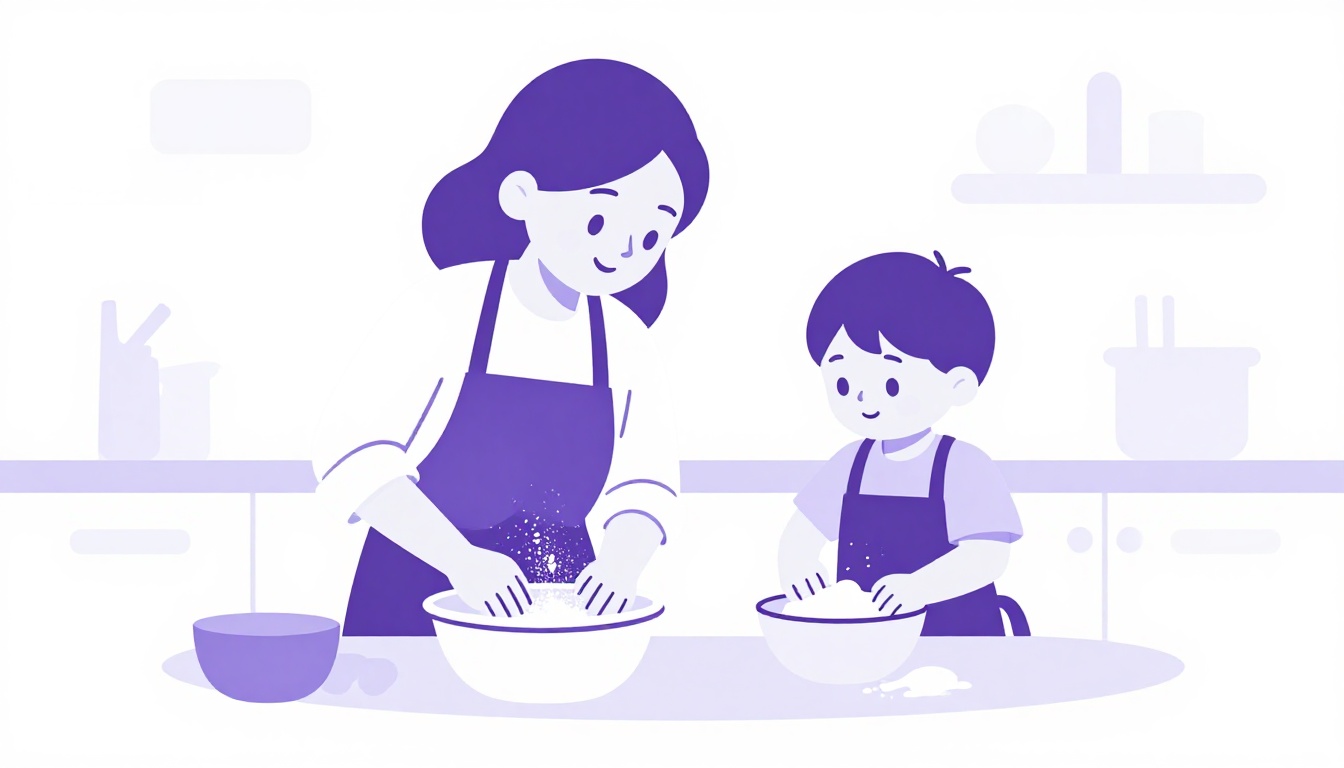
That last sentence is worth pausing on, because sleeping over at grandma's is a genuinely common tradition in Brazilian families, tied closely to how Portuguese family vocabulary tends to describe extended family as close and constantly present, not distant relatives you see twice a year. A vocabulary note from Sublearn on vovó and vovô confirms the same pattern: these are the default household words, not baby talk that gets phased out.
Vó: the short, everyday version
If "vovó" is warm, "vó" is warm and quick. Drop one syllable and you get "vó," pronounced simply "VAW." It works exactly like clipping "grandma" down to "gram" or "nan" in English: same person, same affection, just faster.
You will see "vó" constantly in texting and casual speech. "Oi vó, tudo bem?" (Hi grandma, everything good?) is a completely normal way to open a message. A direct explainer on how to say grandma in Portuguese from Brazilian Gringo lays out this exact split between "avó," "vovó," and "vó" as three points on the same formality scale, from most neutral to most casual, and that scale is the single most useful mental model for this whole topic. Once you have it, every other word in this article is just a variation on the same idea.
One nuance: "vó" on its own, without context, can occasionally read as slightly blunt in writing, the way "gram" reads more casual than "grandma" in an email. In speech it is completely normal and you will hear adults use it their whole lives, not just as kids.
Great-grandma and beyond
Portuguese builds upward from "avó" with a clean, predictable prefix. Add "bis-" and you get "bisavó," great-grandmother, confirmed directly in Wiktionary's entry for bisavó. Go one generation further and you reach "trisavó" or "tresavó" for great-great-grandmother, though in daily conversation most families just say "minha bisavó" and then explain the relationship in plain language rather than reaching for a fourth-generation term.
This same "bis-" pattern shows up across Portuguese family vocabulary once you start looking for it, and it is one of the more satisfying parts of learning the language, because a handful of building blocks unlock a whole tree of relatives. A grandchild is "neto" or "neta." An uncle or aunt is "tio" or "tia." A cousin is "primo" or "prima." A nephew or niece is "sobrinho" or "sobrinha." A brother or sister is "irmão" or "irmã." Resources like Practice Portuguese's family members guide, Preply's rundown of Portuguese family vocabulary, and Babbel's guide to family in Portuguese all cover this same set, and it is genuinely worth learning as a block rather than one word at a time, since the masculine and feminine pairs share the same root and just swap the final vowel.
| Relationship | Portuguese | Notes |
|---|---|---|
| Grandmother | avó / vovó | Formal vs. warm, as covered above |
| Great-grandmother | bisavó | Same pattern for great-grandfather: bisavô |
| Grandchild | neto (m) / neta (f) | What a grandmother calls her grandkids |
| Aunt / uncle | tia / tio | Also used loosely for close family friends |
| Cousin | prima / primo | Gender follows the cousin, not the speaker |
| Niece / nephew | sobrinha / sobrinho | Same masculine/feminine ending pattern |
| Sister / brother | irmã / irmão | Note the nasal "ão" ending on the masculine |
Guides like Migaku's Portuguese family vocabulary post, Rio & Learn's family in Portuguese lesson, Rocket Languages' family vocabulary page, The Brazilian Ways' family vocabulary breakdown, and TryKaiwa's Portuguese family vocabulary list all circle back to this same core set of terms, which tells you something useful: this is a stable, well-agreed vocabulary list, not one where sources disagree. Learn it once and it holds up everywhere in the Portuguese-speaking world.
Regional nicknames: vozinha, voinha, and Portugal's avozinha
Beyond "vovó" and "vó," you will also run into softer, more affectionate nicknames, especially in the Northeast of Brazil. "Vozinha" and "voinha" both translate loosely to "little grandma," built from the diminutive suffix "-inha" that Portuguese uses constantly to add warmth to a word. A family vocabulary breakdown from Streetsmart Brazil covers exactly this regional pattern, noting that these diminutive forms are common terms of endearment rather than formal alternatives you would use with a stranger.
Portugal leans a different direction. While Brazilians default to "vovó," speakers in Portugal more often reach for "avozinha," the diminutive of "avó" itself, following the same "-inha" logic but built on the formal root instead of the reduplicated one. If you are learning Portuguese specifically to talk with family in Portugal rather than Brazil, "avozinha" is worth learning alongside "avó," the same way this matters for other everyday phrases, since European and Brazilian Portuguese diverge in small but real ways across vocabulary and pronunciation, not just accent.
None of these regional nicknames are wrong or "less correct." They are simply warmer, the linguistic equivalent of calling someone "sweetheart" instead of using their name. If your partner's grandmother is from Recife or Salvador, do not be surprised if "vozinha" is what the whole family uses.

The "Vozinha" story from the 2026 World Cup
Here is a real, current example that makes this whole word family stick in your memory. At the 2026 FIFA World Cup, a Cape Verdean goalkeeper became a breakout story after a string of remarkable saves in a match against Spain. His nickname, used by teammates and fans alike, was "Vozinha," little grandma.
The story behind it is exactly what you would expect once you know the word: as a kid, he was always running off to visit his grandmother, so his friends started calling him "Vozinha" as an affectionate, slightly teasing nickname, and it stuck for the rest of his life. A profile from HITC on the goalkeeper who frustrated Spain on his World Cup debut and a deeper dive into the story behind the Vozinha nickname both confirm the grandmother connection. When the story went viral, some English-language coverage mistranslated the nickname entirely, prompting a correction on social media explaining that "vozinha" uses the "-inho/-inha" diminutive and that "vó" simply means grandma. It is a small linguistic footnote to a World Cup story, but it is also a genuinely useful memory hook: a grown man, nicknamed after his grandmother, becoming a household name on the world's biggest sporting stage, all because as a boy he loved her enough that it followed him into adulthood.
Why Portuguese-speaking families have so many words for grandma
Here is the piece that ties all of this together: the sheer number of warm words for "grandma" is not an accident of the language. It reflects how present grandmothers actually are in Brazilian and Portuguese family life, which tends to look quite different from the "see them at Thanksgiving and maybe once in the summer" pattern common in English-speaking nuclear families.
Multi-generational households are far more common in Brazil than in the United States, the United Kingdom, or Canada. It is completely normal for a grandmother to live in the same house as her children and grandchildren, or a short walk away, rather than a plane ride away. Sunday lunch, "almoço de domingo," is a near-institution in many Brazilian families, and grandma is very often the one cooking it, the one everyone shows up for, the anchor the whole week bends around. Ask a Brazilian person what they did last Sunday and there is a decent chance the answer involves rice, beans, and "a casa da vovó."
Grandmothers also frequently step in as a default childcare figure, picking kids up from school, watching them after work hours, sometimes helping raise them for stretches of time. That kind of daily, physical closeness is exactly the environment where a formal word like "avó" naturally softens into something a toddler invents and everyone else adopts, because the person being described is not a distant relative you address politely twice a year. She is someone whose kitchen you know the smell of, whose voice you have heard every single day of your life. Once you see grandma this way, in this culture, the entire cluster of words in this article stops looking like a vocabulary quirk and starts looking like exactly what it is: a language with more affectionate words for grandmother because it has more affectionate, daily relationships with grandmothers to describe.

Pronunciation deep dive: avó vs. avô
Now for the part that trips up almost every English speaker, including ones who have studied Portuguese for years. "Avó" (grandmother) and "avô" (grandfather) look nearly identical on the page, one letter apart, but they are not interchangeable, and mixing them up is an easy way to accidentally call your grandmother-in-law a grandfather in front of the whole family.
The difference lives in the accent mark. The acute accent on "avó" signals an open "o," roughly the vowel sound in the English word "law" or "saw." The circumflex accent on "avô" signals a closed "o," closer to the vowel in the English word "so" or "go." English speakers' ears often miss this distinction entirely, because English does not use accent marks to encode vowel openness the way Portuguese does, and both sounds can blur together if you are listening quickly. Practice Portuguese's pronunciation guide for vowels and Remitly's guide to Portuguese vowels both walk through this open-versus-closed distinction with everyday word examples, and the IPA reference page for Portuguese on Wikipedia gives you the exact phonetic symbols if you want to go deeper.
| Form | Sound | Meaning |
|---|---|---|
| avó | open "o," like "aw" | grandmother |
| avô | closed "o," like "oh" | grandfather |
| avós | open "o," plural | grandmothers, or grandparents together |
| avôs | closed "o," plural | grandfathers |
Notice that "avós" (with the open vowel and acute accent) can mean either "grandmothers" plural or "grandparents" as a pair, the way you might say "my grandparents are visiting" in English without specifying gender. Context almost always makes it obvious which one is meant.
A practical drilling trick: exaggerate the difference at first, on purpose, even past the point of sounding natural. Say "avó" with your jaw dropped wide, like you are yawning, then say "avô" with rounded, tighter lips, like you are about to whistle. Doing this a few times out loud trains the muscle memory your mouth needs, because reading the difference on a page and actually producing it with your voice are two completely separate skills. This is exactly the kind of distinction that clicks faster with repetition out loud than with any amount of silent reading, which is the whole idea behind speaking-first practice tools like app.usecomigo.com: you say the word, you hear how close or far you are, and you adjust, the same way you would if a person were correcting you in real time.
Common mistakes English speakers make
Even careful learners trip over this word family in a handful of predictable ways. Here are the ones worth watching for.
Mixing up avó and avô. This is the big one, covered above, and it is the mistake that actually changes the meaning of your sentence rather than just sounding slightly off.
Dropping the article. In Portuguese, family words almost always take an article: "a avó," "a vovó," "o avô." English speakers used to saying "grandma called" with no article often say "vovó ligou" and skip it, when Brazilians would more naturally say "a vovó ligou." It is a small habit, but it is one of the fastest ways to sound more natural fast.
Putting the stress on the wrong syllable. Portuguese stress rules are fairly consistent, but "avó" still surprises people who default to English stress patterns and land hard on the first syllable instead of the second. Say it "ah-VAW," not "AH-vaw."
Assuming "vovó" is unisex. It is not. "Vovó" is grandma, "vovô" is grandpa, and they follow the exact same open-versus-closed vowel rule as "avó" and "avô." Learners sometimes assume the reduplicated forms are somehow gender-neutral because they sound cute, but Portuguese keeps the masculine and feminine distinction all the way through the family word system.
Capitalizing family words out of English habit. In English, "Grandma" is often capitalized when used as a name ("I'm visiting Grandma this weekend"). In Portuguese, "avó" and "vovó" are lowercase in almost every context, even when used the same way, as a name-substitute. Capitalizing them looks like a small tell that you are translating directly from English in your head.
Skipping the accent mark when typing. On a phone keyboard without easy accent access, it is tempting to type "avo" and move on. Do it enough and you build a habit that makes your written Portuguese harder to read and, worse, makes it harder for your own brain to remember which vowel sound goes with which word. If accent marks feel like a hurdle in general, a guide to spelling in Portuguese is worth a look, since accented vowels come up constantly, not just with grandma.
Letting autocorrect swap avó for avô. This one is sneakier than it sounds. Plenty of phone keyboards, especially ones set to a generic Portuguese dictionary rather than Brazilian Portuguese specifically, will "correct" a typed "avó" to "avô" or flag it as a typo, since the keyboard sometimes treats the circumflex form as the more common default. Always glance back at the accent mark before you hit send, particularly in a message you are writing quickly.
Reaching for "vovó" in a context that calls for "avó." The mistake usually runs one direction, learners forgetting to warm up their language and staying too formal, but it can go the other way too. A school form, a medical intake sheet, or a formal letter asking about "a avó da criança" (the child's grandmother) reads oddly if you write "a vovó da criança" instead. It is not incorrect exactly, but it is the same mismatch as writing "my grandma's medical history" on an official hospital form instead of "grandmother." Save "vovó" for speech and warm, personal writing, and reach for "avó" when the context is neutral or official.
Grandma phrases you'll actually use
Vocabulary lists are useful, but full sentences are what you will actually need at a family dinner. Here are phrases that come up constantly around grandmothers in Brazilian and Portuguese households, several of which connect to other everyday phrases worth learning alongside them.
| Portuguese | English | Usage note |
|---|---|---|
| Oi, vovó! | Hi, grandma! | The most common opener, works any time of day |
| Bom dia, vovó! | Good morning, grandma! | Pairs naturally with a full good morning greeting |
| Boa tarde, vovó! | Good afternoon, grandma! | See the full good afternoon phrase guide for more context |
| Como você está, vovó? | How are you, grandma? | Covered in depth in how are you in Portuguese |
| Eu te amo, vovó. | I love you, grandma. | See the broader I love you in Portuguese guide for tone and variations |
| Obrigado(a), vovó. | Thank you, grandma. | Explored further in how to say thank you in Portuguese |
| Vou visitar a vovó no fim de semana. | I'm going to visit grandma this weekend. | A very common plan to announce in a family group chat |
| Feliz aniversário, vovó! | Happy birthday, grandma! | Full phrase breakdown in happy birthday in Portuguese |
| Tchau, vovó, até logo! | Bye, grandma, see you soon! | Compare with the full range of options in goodbye in Portuguese |
| A vovó fez o jantar. | Grandma made dinner. | Grandmothers and cooking are deeply linked in Brazilian culture, see food in Portuguese |
A few of these are worth a second look. "Eu te amo, vovó" is genuinely something you will hear kids say constantly, and it pairs with the same warm, affectionate register as "vovó" itself, not the more neutral "avó." If you are learning how to greet people generally, the same politeness patterns that show up when you say hello in Portuguese or offer a simple please apply just as much inside the family, maybe more, since grandparents in Brazilian culture are often treated with a specific, warm kind of respect that blends formality and closeness at the same time.

Writing to grandma: cards, WhatsApp, and letters
Speaking to grandma and writing to her are two slightly different skills, and Brazilian family life runs on both. WhatsApp in particular is where most day-to-day contact with grandma happens now, short voice notes and quick texts replacing the phone calls of a generation ago, so it is worth knowing a few more phrases built specifically for writing rather than speaking.
A birthday card, a WhatsApp message, and a handwritten letter each call for a slightly different register, but "vovó" works comfortably in all three, since warmth is rarely out of place when you are writing to your own grandmother. A more formal card, the kind you might buy at a store with a printed message inside, is one of the few places you will still see "avó" in a personal, affectionate context, since printed cards are often written to suit any family rather than one specific relationship.
| Portuguese | English | Usage note |
|---|---|---|
| Parabéns, vovó, te amo muito! | Congratulations, grandma, I love you so much! | A standard birthday card line, "parabéns" works for both congratulations and happy birthday |
| Saudades, vó! | I miss you, grandma! | "Saudades" has no exact English equivalent, but this is the closest everyday phrase to "missing you" |
| Manda um beijo pra vovó. | Send grandma a kiss. | Common closing line parents say to kids before hanging up a call |
| Que horas você chega, vovó? | What time do you arrive, grandma? | Handy before a visit, pairs with telling time in Portuguese |
| Bênção, vó, chego domingo! | Blessing, grandma, I'll arrive Sunday! | A quick WhatsApp message combining the blessing custom with travel plans |
Texting shortcuts are worth knowing too. Brazilians commonly drop the accent mark entirely in fast typing, sending "vo" or "avo" and trusting context to fill in the gap, the same way an English speaker might type "ur" instead of "your" in a quick message. This is different from the accent mistakes covered earlier, since it is a deliberate shortcut rather than an error, but it only works because the person reading it already knows the word. When you are the one learning, it is worth typing the accent out in full until the word is second nature, the same logic behind spelling things out fully rather than reaching for shortcuts you have not earned yet. A short "sim" is also a completely normal, complete reply on its own if grandma asks whether you are coming for lunch, no extra words required, the same simple economy covered in yes in Portuguese.
"Bênção, vovó!": the family blessing custom
One tradition you will notice quickly in Brazilian families is the "bênção" exchange. A child approaching a grandparent, or really any older relative, will often say simply "bênção," short for "peço a bênção" (I ask for your blessing). The elder responds with something like "Deus te abençoe" (God bless you) or a shorter "abençoado" (blessed).
It happens fast, almost like a greeting, and it happens constantly: when a child arrives at a grandmother's house, when they leave, sometimes both. "Bênção, vovó!" followed by "Deus te abençoe, meu filho" is such a normal exchange that many Brazilian families do it on autopilot, the way an English-speaking family might automatically say "love you, bye" at the end of a phone call without really thinking about the words individually.
If you are new to a Brazilian family, this custom can catch you off guard the first time you hear it, since nothing quite like it exists in most English-speaking households. Learning the phrase and the expected response ahead of time means you will not be caught flat-footed the first time a niece or nephew says "bênção" to you and waits for an answer.
Dia dos Avós: Brazil's Grandparents Day
Brazil celebrates Dia dos Avós, Grandparents Day, on July 26th, the same date recognized in the Catholic calendar for Saint Joachim and Saint Anne, traditionally regarded as the grandparents of Jesus. A detailed history of the holiday from Gazeta do Povo traces the date back to this religious origin, and Calendarr's overview of Dia dos Avós confirms the same July 26th date alongside how it is marked today.
On this day, cards, messages, and social media posts across Brazil lean almost entirely on the warm words rather than the formal one. You will see "Feliz Dia dos Avós, vovó" far more often than the equivalent using "avó," which tells you something real about how the language sorts itself: the formal word survives in writing and neutral description, but the moment real affection enters the picture, Brazilian Portuguese reaches for "vovó" almost automatically. The Portuguese Wikipedia entry on Dia dos Avós covers the holiday's spread across Brazil in more detail, and if you want the international context, the English Wikipedia page on Grandparents' Day shows how differently countries schedule and celebrate this same idea, some in September, others tied to specific saints' days like Brazil.
If you are trying to build out your calendar knowledge in Portuguese generally, this is also a good moment to review the days of the week in Portuguese, since dates like "26 de julho" come up constantly around holidays like this one, right alongside other big ones like Christmas in Portuguese.

Where the word comes from
"Avó" has a long history behind it. It traces back to the Latin "avia," the feminine form of "avus," meaning grandfather or ancestor more broadly. Wiktionary's entry for the Latin root avus shows this etymology clearly, and that same Latin root sits behind a whole family of related words across the Romance languages, since Spanish "abuela" and the older forms behind Italian's grandparent vocabulary both trace to close cousins of the same Latin base, even though each language went its own direction from there.
"Vovó," on the other hand, is not a direct descendant of Latin. It is a newer, homegrown reduplication that Brazilian Portuguese built on top of "avó" itself, repeating the syllable the way toddlers naturally do, the same process behind "vovô," "papai," and "mamãe." This is worth knowing because it explains why "vovó" feels so distinctly Brazilian and domestic: it was not inherited from Latin, it was built inside Portuguese-speaking households, generation after generation, as a warmer, easier-to-say version of an older, more formal word.
This same split, one formal word straight from Latin and one warmer household word invented later, is common across the Romance languages, not unique to Portuguese. Spanish "abuela" comes from the same Latin root as "avó," and Spanish speakers use it comfortably in both formal and warm contexts, though Spanish also has its own affectionate variants families reach for at home, the same general pattern as Portuguese even if the specific words differ. It is safer to describe this as a broad family resemblance across Romance languages rather than a precise rule that applies identically everywhere, since each language developed its own household nicknames on its own timeline, shaped by its own history rather than a shared, coordinated one.
How other languages say a warm "grandma"
Almost every language has this same split: one word you would use writing a form, and a warmer one you would actually call your grandmother. Seeing them side by side makes the Portuguese pattern easier to remember.
| Language | Warm word for grandma |
|---|---|
| Portuguese | Vovó |
| Spanish | Abuela |
| Italian | Nonna |
| German | Oma |
| French | Mamie |
This pattern, a formal word and a warmer household word existing side by side, shows up across cultures constantly, and it is one reason lists of cross-cultural grandparent nicknames tend to find so much overlap once you look past the specific sounds: nearly every family, in every language, ends up with a shorter, softer version of "grandmother" that the kids invent or adapt first, and the adults never fully stop using. Spanish is a useful comparison point here because "abuela" itself already reads warmer day to day than the English "grandmother," even without a separate childish nickname the way Portuguese has "vovó," which shows that this formal-versus-warm split does not always split into two completely different words. Sometimes, as in Spanish, one word simply stretches to cover both registers depending on tone of voice.
How to actually make it stick
Reading this whole article will not, by itself, teach your mouth to say "avó" correctly instead of accidentally saying "avô." That takes actual repetition, out loud, ideally with some kind of feedback telling you whether you got it right. This is true of almost everything in language learning, but it is especially true of a pair of words that differ by one vowel sound your English-trained ear was never built to distinguish.
That is the entire idea behind Comigo: a speak-first approach where you say words out loud, play short games, and practice real phrases with feedback, instead of silently tapping multiple-choice answers and hoping the sound sinks in through osmosis. Capy, the app's capybara companion, is there for the reps that actually matter, the ones where you open your mouth and try. If you want to see how this works, or you are curious about the broader approach behind it, Comigo in English is a good starting point, and one learner's account in how I learned Portuguese walks through what that process actually looked like day to day. When you are ready to try saying "avó" and "avô" out loud yourself and see how close you get, app.usecomigo.com is where to start.
Frequently asked questions
Is avó or vovó more common? In everyday spoken Brazilian Portuguese, "vovó" is far more common. "Avó" is the correct, neutral word you will find in dictionaries and formal writing, but most families call their grandmother "vovó" or the shortened "vó" in daily life.
How do you pronounce avó correctly? Say it "ah-VAW," with an open "o" sound like the "aw" in "saw," and stress on the second syllable. Be careful not to slide into "avô," which uses a closed "o" and means grandfather instead.
What do Brazilian kids call their grandmother? Most Brazilian kids call their grandmother "vovó," and many shorten it further to "vó" as they get older. Regional nicknames like "vozinha" or "voinha" are also common, especially in Northeast Brazil.
Is vovó used for grandpa too? No. "Vovó" specifically means grandma. Grandpa is "vovô," using the same reduplicated pattern but with the closed "o" sound instead of the open one. The two words are gender-specific, not interchangeable.
What is bisavó? "Bisavó" means great-grandmother, built by adding the prefix "bis-" to "avó." A great-grandfather is "bisavô," and a great-great-grandmother is sometimes called "trisavó" or "tresavó," though families often just describe the relationship in plain words instead.
Does grandma in Portuguese change between Portugal and Brazil? The core words, "avó" and "vovó," are used in both countries. The main regional difference is in the affectionate diminutive: Brazilians, especially in the Northeast, often say "vozinha" or "voinha," while speakers in Portugal more commonly say "avozinha."
How do you say great-grandma in Portuguese? Great-grandma is "bisavó." It follows the same pronunciation pattern as "avó," with stress on the final syllable and an open "o" sound.
What is Dia dos Avós? Dia dos Avós is Brazil's Grandparents Day, celebrated on July 26th. The date comes from the Catholic feast day of Saint Joachim and Saint Anne, traditionally honored as the grandparents of Jesus, and it is widely marked with cards and messages using the warmer word "vovó."
How do you write grandma in a birthday card in Portuguese? "Parabéns, vovó" (congratulations, grandma) is the standard opener for a birthday card, often followed by a warm line like "te amo muito" (I love you so much). "Vovó" fits comfortably in a card, since a birthday message is exactly the kind of warm, personal writing where the affectionate word belongs.
What does vozinha mean literally? "Vozinha" is built from "vó" (grandma) plus the diminutive suffix "-inha," so it literally means "little grandma." The same suffix is used across Portuguese to add warmth or smallness to a word, not just with family terms.
Is there a Mother's Day equivalent specifically for grandmothers? Not exactly. Brazil celebrates "Dia das Mães" (Mother's Day) separately in May, focused on mothers, while grandmothers are specifically honored on Dia dos Avós on July 26th alongside grandfathers. There is no separate holiday just for grandmothers on their own.
How do you say "my grandmother" in Portuguese? "My grandmother" is "minha avó" in a neutral or formal context, or "minha vovó" when speaking warmly, the way you actually would with family. Both use the feminine possessive "minha," matching the feminine noun.
Is it rude to call your grandmother avó instead of vovó? No, it is not rude at all. "Avó" is simply more formal and neutral. It will not offend anyone, but it may sound a little distant or textbook-like compared to the warmer "vovó" that most families actually use day to day.
Wrapping up
Five words, one grandmother: avó for the dictionary, vovó for the kitchen table, vó for a quick text, vozinha or avozinha for extra warmth, and bisavó once you go back another generation. None of them is wrong. They just sit at different points on the same scale from formal to affectionate, and once you can hear that scale, the rest of Portuguese family vocabulary starts to make a lot more sense too. The fastest way to make any of it stick is still the simple one: say the words out loud, get them wrong a few times, and keep going. That is what app.usecomigo.com is built for.
Related guides
- Rosetta Stone vs BabbelRosetta Stone vs Babbel: price, method and which one to pick.
- Rosetta Stone vs DuolingoRosetta Stone vs Duolingo: free vs paid, method and results.
- italki vs Preplyitalki vs Preply: pricing models, tutors and which is better.
- Busuu vs DuolingoBusuu vs Duolingo: which app actually teaches more.


