
Hail Mary in Portuguese is "Ave Maria." The full prayer opens with "Ave Maria, cheia de graça, o Senhor é convosco," which means "Hail Mary, full of grace, the Lord is with thee." That is the answer. The rest of this guide gives you everything around it.
You may have a grandmother who prays it. You may have heard it in a film, a song, or a church in Lisbon or São Paulo. You may be learning Portuguese and hit the words "convosco" and "rogai," and wondered why nobody says them at the bus stop. Whatever brought you here, you'll leave with the exact text, a line by line English translation, a pronunciation guide, and the small differences between Brazil and Portugal.
We treat the prayer with respect. For many readers it is a sincere prayer, and for others it is a piece of culture. Our job is the language: what each word means, how it sounds, and why it looks so old. And since reading a prayer is not the same as saying it, we built Comigo around speaking out loud, where Capy the capybara listens and gives you feedback on each word, with no one watching but Capy.
How Do You Say Hail Mary in Portuguese? The Quick Answer
The name of the prayer is "Ave Maria," which the Portuguese Wikipedia article on the Ave-Maria describes as one of the best known prayers of Christianity. The word "Ave" is Latin for "hail," so "Ave Maria" is the same greeting the English "Hail Mary" translates. It also has a few other jobs in Portuguese, and they matter if you want to read real texts.
| Portuguese | English | Note |
|---|---|---|
| Ave Maria | Hail Mary | The name of the prayer, and the first two words |
| a ave-maria | a Hail Mary, one recitation of the prayer | Noun, written with a hyphen |
| as ave-marias | the Hail Marys, also the evening bell and dusk | See the section on the Ângelus |
| rezar uma Ave-Maria | to say a Hail Mary | "Rezar" is the everyday verb for praying |
| Ave Maria! | Wow! Goodness me! | Casual exclamation, especially in Brazil |
| Hail Mary (esportes) | a desperate long pass in American football | Used as a loan phrase in sports writing |
The English Wikipedia article on the Hail Mary says the prayer is a traditional Christian prayer to Mary, mother of Jesus. It has two parts. The first is a pair of greetings taken from the Gospel of Luke. The second is a request added later. We'll look at both.

If you only need one line to carry away, take this one: Hail Mary in Portuguese is "Ave Maria," and the prayer is almost the same in Brazil and Portugal. If you want to say it well, keep reading. There is a lot more to it than a translation, and most pages online skip it.
The Full Hail Mary in Portuguese (Brazilian Text)
Here is the prayer as Brazilian Catholic sites print it. You can compare it with the version on Hozana's Hail Mary page in Portuguese, which shows the Portuguese and English side by side, and with the Oração e Fé page on the Ave-Maria.
Ave Maria, cheia de graça, o Senhor é convosco. Bendita sois vós entre as mulheres, e bendito é o fruto do vosso ventre, Jesus. Santa Maria, Mãe de Deus, rogai por nós, pecadores, agora e na hora de nossa morte. Amém.
Now the same prayer, one line at a time. The English column uses the traditional wording most English speakers know, and the last column says what the line means in plain words.
| Portuguese | English (traditional) | What it means |
|---|---|---|
| Ave Maria, cheia de graça, | Hail Mary, full of grace, | A greeting. Mary is addressed as someone full of grace. |
| o Senhor é convosco. | the Lord is with thee. | "The Lord is with you." |
| Bendita sois vós entre as mulheres, | Blessed art thou among women, | "You are blessed among all women." |
| e bendito é o fruto do vosso ventre, Jesus. | and blessed is the fruit of thy womb, Jesus. | The "fruit" of her womb is her son, Jesus. |
| Santa Maria, Mãe de Deus, | Holy Mary, Mother of God, | The second part begins here, with a new title. |
| rogai por nós, pecadores, | pray for us sinners, | A request: "pray for us, who make mistakes." |
| agora e na hora de nossa morte. | now and at the hour of our death. | "Now" and at the end of life. |
| Amém. | Amen. | "So be it." |
Notice the shape. The first four lines are greetings. The last four are a petition. That split will come back when we look at where the words came from.
Modern English usually says "the Lord is with you," "blessed are you among women," and "the fruit of your womb." Portuguese has no such modern version in daily use. Many people still say the old words, "convosco" and "sois," even when they speak very differently the rest of the day. That is part of what makes it feel timeless, and part of what makes it hard for learners. We'll open that up in a moment.
The wording comes from two moments in the Gospel of Luke, and you can read both in English at Bible Gateway's Luke 1. The greeting "full of grace, the Lord is with you" is the angel's greeting. "Blessed are you among women, and blessed is the child you will bear" comes from Elizabeth. Both scenes are in the section on history below.
Hail Mary in Portuguese: Brazil vs Portugal
Good news. This is one prayer, not two. The Portuguese language has two big standards, Brazilian Portuguese and European Portuguese, and they differ in sound, spelling, and slang. But the Hail Mary is a fixed text that people memorize, so it barely moves.
Here is the Portugal wording from Vatican News in Portuguese, which uses European spelling:
Avé Maria, cheia de graça, o Senhor é convosco, bendita sois vós entre as mulheres e bendito é o fruto do vosso ventre, Jesus. Santa Maria, Mãe de Deus, rogai por nós pecadores, agora e na hora da nossa morte. Ámen
Put the two side by side and the differences are small.
| Where | Brazil | Portugal | Note |
|---|---|---|---|
| Opening word | Ave Maria | Avé Maria | The accent shows up on that Vatican page, and printed prayer cards vary |
| Comma after "nós" | rogai por nós, pecadores | rogai por nós pecadores | Both are common, the comma is a style choice |
| Time of death | na hora de nossa morte | na hora da nossa morte | Portuguese often adds the article "a" before "nossa" |
| Last word | Amém | Ámen | The Portugal page uses "Ámen" spelling, most places write "Amém" |
| Everything else | same | same | Same words, same order |
Read that table again. Four small changes in eight lines. If you learn the Brazilian text, someone in Portugal will follow every word, and the other way round. The extra "a" in "da nossa morte" is a habit of European Portuguese, where articles before possessives like "nossa" are more common. In Brazil people often leave it out.
Both countries have deep Catholic roots. The Catholic Church in Brazil is one of the largest in the world, and the Catholic Church in Portugal has a long history of its own. In both places you will meet older people who know the prayer by heart in this exact traditional form.

The "tu" version you may hear in songs
There is one more variant. Some Portuguese hymns and sung versions use the informal "tu" form instead of "vós." You may see lines like this:
| Traditional prayer (vós) | Some sung versions (tu) | English |
|---|---|---|
| o Senhor é convosco | o Senhor está contigo | the Lord is with you |
| bendita sois vós entre as mulheres | bendita és tu entre as mulheres | blessed are you among women |
| bendito é o fruto do vosso ventre | bendito é o fruto do teu ventre | blessed is the fruit of your womb |
We saw these in Portuguese hymns, but the version people memorize and pray at home is the one with "convosco" and "sois vós." If you are learning the prayer to say it with others, use the "vós" text unless someone tells you otherwise. If you meet the "tu" form in a song, you now know why. It is the same greeting in a more familiar voice. For more on the informal "you," see our guide to how to say "do you speak Portuguese", where "você" and "tu" show up in real questions.
Word by Word: The Vocabulary Inside the Prayer
The prayer is short, only about 45 words, but almost every word teaches you something. Here is every important word, with its plain meaning. Most of these are still alive in modern Portuguese, and a few are only alive in church.
| Portuguese | English | Note |
|---|---|---|
| Ave | hail | Latin greeting, like "hello" but old and formal |
| Maria | Mary | The name, said with five syllables in "Ave Maria" |
| cheia | full (feminine) | Matches "Maria," so it ends in -a |
| graça | grace | The "ç" sounds like "s" |
| o Senhor | the Lord | Also "sir" or "Mr." in normal speech |
| convosco | with you (plural or formal, old) | From Latin "vobiscum," see the Wiktionary entry for convosco |
| bendita | blessed (feminine) | Said about Mary |
| bendito | blessed (masculine) | Said about Jesus, the "fruit" |
| vós | you (plural or formal, old) | Rare outside prayer, Bible, and old texts |
| entre as mulheres | among women | "Entre" is "between" or "among" |
| fruto | fruit | Here it means "child" |
| ventre | womb, belly | Not the same as "vento" (wind) |
| Santa | holy, saint (feminine) | "Santo" is the masculine form |
| Mãe de Deus | Mother of God | See also the Theotokos title |
| rogai | pray, beg (command to "vós") | From "rogar" |
| nós | us, we | Our guide to we in Portuguese covers "nós" and "a gente" |
| pecadores | sinners | One sinner is "pecador" |
| agora | now | Also common in daily speech |
| hora | hour, moment | Same word as "the hour" in "what time is it" |
| nossa | our (feminine) | Matches "morte" |
| morte | death | Feminine noun |
| Amém | amen | With an accent on the "é" |
The Wiktionary entry for ave-maria lists all the senses of the phrase as a noun. The title "Mãe de Deus" is also linked to the wider story of Mary, mother of Jesus, and the Greek word behind the title has its own page, Theotokos, if you want to go deeper into the vocabulary of the topic.
Four words from that table are useful in everyday Portuguese too: "agora," "hora," "morte," and "nós." Learn those and you have already gained something outside the church. If you are collecting the first hundred words of the language, our list of basic words in Portuguese is a good place to start, and it fits well with the vocabulary here.
Why the Prayer Sounds Old: "Vós," "Convosco," and "Rogai"
If you have studied Portuguese for even a few weeks, three words in this prayer feel wrong. "Vós." "Convosco." "Rogai." Nobody uses them at the market. So what are they?
They belong to "vós," an old second person plural form. In the Portuguese language today, "vós" has mostly left daily speech. In Brazil, "você" and "vocês" took over. In Portugal, "tu" and "você" are common, and "vocês" covers the plural. But "vós" stayed alive in prayers, in the Bible, in formal speeches, and in old literature. That is why the Hail Mary keeps it.
Here is the "vós" family that shows up in the prayer, next to the modern forms.
| Old form (prayer) | Modern everyday form | English |
|---|---|---|
| vós | você, vocês | you |
| convosco | com você, com vocês | with you |
| vosso ventre | seu ventre, o ventre de vocês | your womb |
| sois | é, são | are |
| rogai | roga (tu), rogue (você), roguem (vocês) | pray, ask |
Look at "sois." It is the "vós" form of the verb "ser," which means "to be." The modern forms are "é" for one person and "são" for several. If you want to see the whole table of "ser," including "sois," our guide to ser conjugation in Portuguese has it laid out. Here is the short version.
| Person | Form of "ser" | English |
|---|---|---|
| eu | sou | I am |
| tu | és | you are (informal) |
| você, ele, ela | é | you, he, she is |
| nós | somos | we are |
| vós | sois | you all are (old) |
| vocês, eles, elas | são | you, they are |
So "Bendita sois vós" is literally "Blessed are you," with both the verb and the pronoun in the old plural form. Speakers of English know the same effect from "thou art," which sounds old but is part of a very grammar-perfect system. Portuguese has the same thing, just a bit more alive because the prayer is still said every day.

"Rogai" and the imperative
"Rogai por nós" is a command, but a polite, praying one. The verb "rogar" means "to beg, to ask, to pray for." The ending "-ai" is the "vós" imperative for verbs that end in "-ar." Take "falar," to speak: "falai" is the "vós" command, "speak (all of you)." Same pattern, same ending.
| Verb | Vós command | Meaning |
|---|---|---|
| rogar | rogai | pray, ask |
| falar | falai | speak |
| louvar | louvai | praise |
| orar | orai | pray |
The Cambridge Portuguese-English dictionary entry for convosco confirms that "convosco" is the old form of "with you," and that in everyday speech you say "com vocês." To sound natural in a normal conversation, use that instead. And if "rogai por nós" feels similar to a request for help, it is. For polite requests in daily Portuguese, look at our guide to saying please in Portuguese, where the everyday equivalents live.
Here is the one rule to keep. Use "vós" forms in the prayer, and modern forms everywhere else. Mixing them in a chat would sound like reading Shakespeare aloud to order coffee.
How to Pronounce the Ave Maria in Portuguese
This is the part most pages skip. And it is the part that matters, because most learners want to say the words, not just read them.
The word "ave-maria" has five syllables. The Wiktionary entry gives the Brazilian sound as /ˌa.vi.maˈɾi.ɐ/ and the European sound as /ˌa.vɛ.mɐˈɾi.ɐ/. In some parts of northern Portugal, the "v" can sound like a "b," giving /ˌa.bɛ.mɐˈɾi.ɐ/. Read those slowly and you see the main point. The stress lands on the fourth syllable, "RI," in both countries. Say it like this: ah-vee-mah-REE-ah.
The big difference between the two countries is vowels. Brazilian Portuguese vowels are clearer and more open, while European Portuguese tends to shorten or drop unstressed vowels. The Practice Portuguese guide to European vowels and the Remitly guide to Portuguese vowels both explain this well. In practice, a Brazilian will say each syllable of "Ave Maria" more fully, and a person from Lisbon will squeeze the middle.
Here is a respelling of the whole prayer in English letters. It is approximate, and it leans toward the Brazilian sound. Native audio beats any respelling, so treat this as scaffolding.
| Portuguese | Rough English respelling | Watch out for |
|---|---|---|
| Ave Maria | AH-vee mah-REE-ah | Stress the "REE" |
| cheia de graça | SHAY-ah jee GRAH-sah | "ei" is like "ay," the "ç" is "s" |
| o Senhor é convosco | oo seen-YOR eh kohn-VOH-skoo | "nh" is like "ny" in "canyon" |
| Bendita sois vós | ben-JEE-tah soyss vohss | "di" often sounds like "jee" in Brazil |
| entre as mulheres | EN-tree ahs moo-LYEH-rees | "lh" is like "lli" in "million" |
| e bendito é o fruto | ee ben-JEE-too eh oo FROO-too | Final "o" sounds like "oo" |
| do vosso ventre, Jesus | doo VOH-soo VEN-tree zheh-ZOOSS | Soft nasal "en" in "ventre" |
| Santa Maria | SAHN-tah mah-REE-ah | "an" is nasal |
| Mãe de Deus | MYNG jee DEH-oosh | "ãe" is one nasal sound |
| rogai por nós | hoh-GUY por nohss | Brazilian first "r" sounds like an English "h" |
| pecadores | peh-kah-DOH-rees | Stress the "DOH" |
| agora e na hora | ah-GOH-rah ee nah OH-rah | "h" is silent in "hora" |
| de nossa morte | jee NOH-sah MOR-chee | In Brazil, "te" often sounds like "chee" |
| Amém | ah-MAYNG | Nasal, do not close the mouth on "ng" |
A few sounds deserve a closer look.
The "ei" in "cheia." This is not "chee-a." It is closer to "SHAY-ah." English learners often say "chee" because the letters "ei" suggest it. Say the "ay" as in "day."
The "nh" in "Senhor." It is a sound English does not have as a letter, but you make it in "canyon." So "Senhor" is close to "sen-YOR."
The nasal endings. Words like "Amém," "ventre," and "vem" pass some air through the nose. It is a small nasal color on the vowel, not a full "m" or "n." The Remitly vowel guide has a section on this.
"Graça." The cedilla makes the "c" sound like "s." So "GRAH-sah," never "GRAH-kah." The second syllable is short and light.
"Convosco." Say it roughly as "kohn-VOH-skoo." The "n" nasalizes the first vowel, and the final "o" becomes "oo."

One more warning. In European Portuguese, unstressed vowels can be dropped or become very short. A speaker from Portugal may say "Ave Maria" so the middle "e" nearly disappears. That is normal. If you are learning from a video of a priest in Lisbon and you feel lost, it is not you. The sound really is more compressed. If you're starting from zero and wondering how tough this all is, our honest take on whether Portuguese is hard to learn covers exactly this.
"Ave Maria" or "Ave, Maria"? Spelling, Accents, and Hyphens
The spelling looks simple, but there are three traps: the comma, the hyphen, and the accent.
The comma. Ciberdúvidas, a Portuguese language advice service, explains that "Ave" is an interjection, like "olá." Grammatically, "Maria" is a vocative, the name of the person you are speaking to, and vocatives are usually set off with commas. So the strict form is "Ave, Maria, cheia de graça." The vocative case works the same way in English: "Hello, John." In everyday practice, most printed prayers write "Ave Maria" with no comma. Both are seen.
The hyphen. When "ave-maria" is a noun, meaning one recitation of the prayer, it takes a hyphen. The plural is "ave-marias." The Priberam dictionary lists it as a noun, with the plural. So: "Rezei três ave-marias," "I said three Hail Marys."
The accent. Some texts print "Avé Maria," as on the Vatican page. Others print "Ave Maria." The accent marks the stress on the last syllable of "Avé" in some spelling habits, but it is not standard in most Brazilian prayer books.
| Form | Where you see it | Comment |
|---|---|---|
| Ave Maria | Most prayer books and websites | Safe default |
| Ave, Maria | Grammar guides | Strict punctuation with the vocative |
| Avé Maria | Some Portuguese pages | A spelling variant |
| ave-maria | Dictionaries | The noun, with a hyphen |
| ave-marias | Dictionaries, texts | The plural |
| Ave Maria! | Speech and comics | An exclamation, not a prayer |
The takeaway: write "Ave Maria" for the name, "ave-maria" for the noun. If you are checking spelling in general, our page on how to spell in Portuguese shows how to talk about accents and letters out loud.
The Latin Version Next to the Portuguese
Portuguese did not invent this prayer. It inherited it from Latin, and the two texts are close cousins. Setting them side by side is one of the best ways to see why the Portuguese words look the way they do.
| Latin | Portuguese | English |
|---|---|---|
| Ave Maria, | Ave Maria, | Hail Mary, |
| gratia plena, | cheia de graça, | full of grace, |
| Dominus tecum. | o Senhor é convosco. | the Lord is with thee. |
| Benedicta tu in mulieribus, | Bendita sois vós entre as mulheres, | Blessed art thou among women, |
| et benedictus fructus ventris tui, | e bendito é o fruto do vosso ventre, | and blessed is the fruit of thy womb, |
| Iesus. | Jesus. | Jesus. |
| Sancta Maria, Mater Dei, | Santa Maria, Mãe de Deus, | Holy Mary, Mother of God, |
| ora pro nobis peccatoribus, | rogai por nós, pecadores, | pray for us sinners, |
| nunc et in hora mortis nostrae. | agora e na hora de nossa morte. | now and at the hour of our death. |
| Amen. | Amém. | Amen. |
You can spot the family resemblance. "Gratia" became "graça." "Benedicta" became "bendita." "Fructus" became "fruto." "Ventris" became "ventre." "Mulieribus" became "mulheres." "Hora" stayed "hora." "Mortis" became "morte." "Nostrae" became "nossa." The Latin "vobiscum," "with you all," is the ancestor of "convosco." That connection is why learning this prayer is a small window into how Portuguese grew out of Latin. Words that look strange at first suddenly look like old friends.
The English prayer above is the traditional one from the English Wikipedia article on the Hail Mary, which also gives the Latin text and the history. If you want to see the Portuguese and Latin lined up with the full liturgical background, Vatican News in Portuguese has its own page for the prayer.
Where the Words Come From: Luke, Gabriel, Elizabeth, and Centuries
The first half of the prayer comes straight from the Gospel of Luke. The second half was added much later. That is the short history, and here is the longer one.
Luke 1:28. The angel Gabriel visits Mary with a greeting. In the Latin Bible, the words are "Ave gratia plena, Dominus tecum," which is where "cheia de graça, o Senhor é convosco" comes from. This scene is called the Annunciation.
Luke 1:42. Mary visits her cousin Elizabeth, who greets her with "Blessed are you among women, and blessed is the fruit of your womb." This scene is called the Visitation. You can read both passages in English on Bible Gateway.
So the first half of the prayer is two greetings, joined together. The word "Jesus" was added at the end of the second greeting. The second half, "Santa Maria, Mãe de Deus, rogai por nós," is a petition, and it arrived later.

How much later? Here is a simple timeline, based on the New Advent entry on the Hail Mary, the Aleteia article on when Christians started praying it, and the English Wikipedia article. Dates in this area are approximate, and scholars discuss them, so read them as a rough guide.
| Period | What happened |
|---|---|
| Before about 1050 | Little evidence that the two greetings were said together as one prayer |
| About the 11th century | The two Gospel verses begin to be combined in prayer |
| 14th and 15th centuries | Petitions such as "pray for us sinners" are added in various forms |
| 1495 | The petition appears in print in a work by Savonarola |
| 1555 | Petrus Canisius includes the prayer with a petition in his writings |
| 1566 | The Catechism of the Council of Trent includes the prayer |
| 1568 | Pope Pius V gives the full form official recognition in the Roman Breviary |
The Council of Trent and the Roman Breviary both have their own pages if you want the wider context. For a modern statement of how the Church explains the prayer, the Catechism of the Catholic Church has a section on the Hail Mary.
Here is a detail that surprises many people. The older form of the prayer ends at "Jesus," before the petition. Some Protestant, Lutheran, and Anglo-Catholic traditions still use that shorter form, according to Oração e Fé and the Portuguese Wikipedia article. So when you hear a shorter version, it is not a mistake. It is an older form that never added the second half.
The English Wikipedia article also notes that the Hail Mary has been translated into about 103 languages. Portuguese is just one of them.
How the Hail Mary Works Inside the Terço and the Rosário
Most people who pray the Hail Mary do not pray it once. They pray it again and again, on beads. That practice is the rosary, and in Portuguese it has two names: "o rosário" and "o terço."
The English Wikipedia article on the Rosary says the full rosary has 150 Hail Marys, and that this number echoes the 150 psalms. The "terço" is one third of that. The name says it: "terço" means "a third." So a terço is five "dezenas," or decades, and each decade is a small loop of prayers. Brazilian Catholic sources such as Canção Nova's guide to praying the terço and the Nossa Senhora das Graças guide on how to pray it lay out the steps.
Here is the structure of one decade.
| Step | Portuguese | English | How many |
|---|---|---|---|
| 1 | Pai-Nosso | Our Father | 1 |
| 2 | Ave-Maria | Hail Mary | 10 |
| 3 | Glória ao Pai | Glory Be | 1 |
The opening and closing of a terço go like this.
| Part | What is said | Note |
|---|---|---|
| Opening | Sinal da cruz | The sign of the cross |
| Opening | Creio | The Creed |
| Opening | Um Pai-Nosso | One Our Father |
| Opening | Três Ave-Marias | Three Hail Marys |
| Opening | Glória ao Pai | One Glory Be |
| Five decades | Pai-Nosso, dez Ave-Marias, Glória | Repeated five times |
| Closing | Salve Rainha | Hail Holy Queen |
So the five decades hold fifty Hail Marys, and a terço has three more at the start. Count the beads and it makes sense. In Portuguese, the beads are "contas." And here is a fun vocabulary link, from the Priberam dictionary: "ave-maria" can also mean a rosary bead, the smaller kind, as opposed to the larger "Pai-Nosso" bead. So "contar ave-marias" can be praying and counting beads at once.
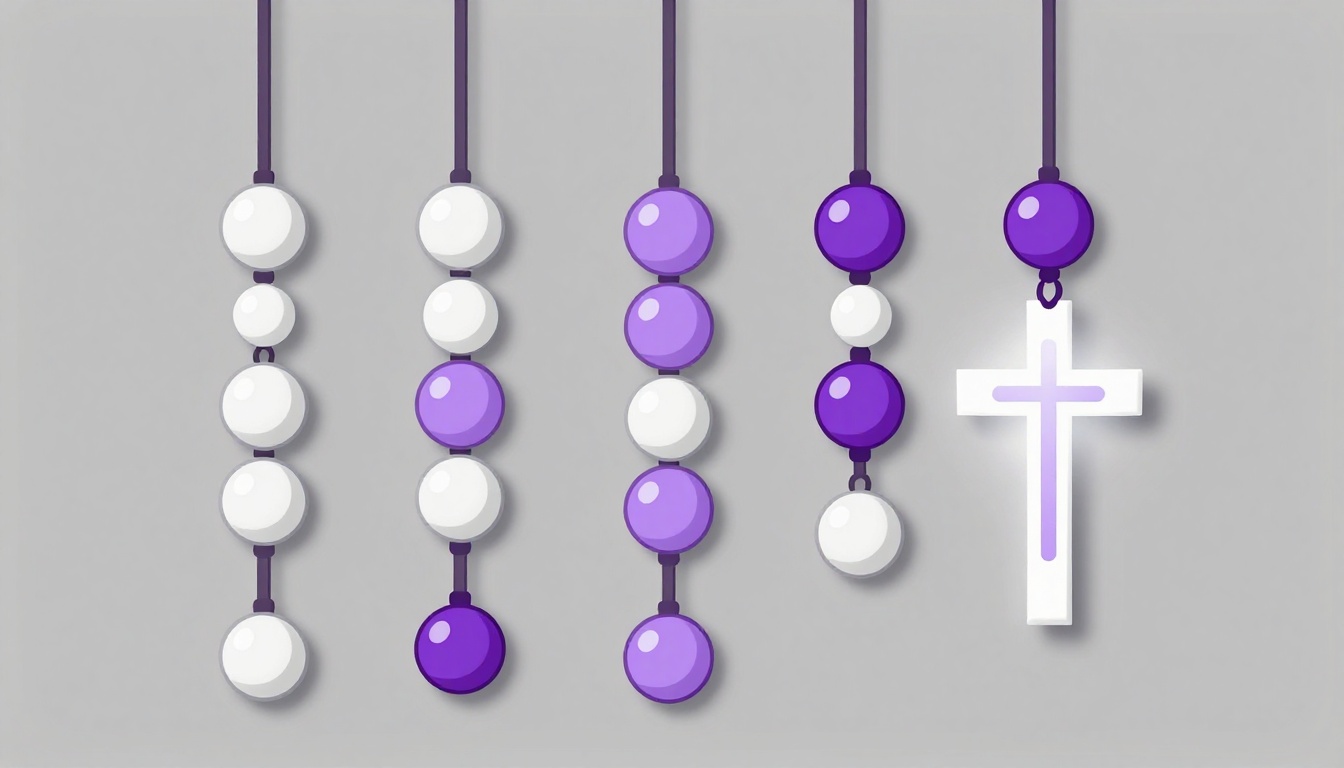
Each decade is tied to a "mistério," a scene from the life of Jesus and Mary that you think about while praying. In Brazilian custom, the sets of mysteries change by day. This schedule follows the one that Canção Nova lists. It is a nice way to practice the days of the week, and our guide to the days of the week in Portuguese will help you with the pronunciation.
| Day (Portuguese) | English | Mysteries (Portuguese) | Meaning |
|---|---|---|---|
| segunda-feira | Monday | gozosos | joyful |
| terça-feira | Tuesday | dolorosos | sorrowful |
| quarta-feira | Wednesday | gloriosos | glorious |
| quinta-feira | Thursday | luminosos | luminous |
| sexta-feira | Friday | dolorosos | sorrowful |
| sábado | Saturday | gozosos | joyful |
| domingo | Sunday | gloriosos | glorious |
The "luminous" mysteries are the newest set. They were added by Pope John Paul II in his 2002 letter, Rosarium Virginis Mariae, which is a good primary source if you want the official explanation of the practice.
In practice, many families in Brazil and Portugal pray the terço together in the evening, and it is often a grandmother who leads. If you want the family words for that scene, our guides to how to say grandma in Portuguese and grandpa in Portuguese give you "avó," "vovó," "avô," and "vovô" with pronunciation. Numbers are everywhere in the terço, too: one Pai-Nosso, ten Ave-Marias, five decades. If you need "dez" and "cinco" cold, see numbers in Portuguese.
The Glória ao Pai, in Portuguese
At the end of each decade you say the "Glória ao Pai." Here it is with English.
| Portuguese | English |
|---|---|
| Glória ao Pai, ao Filho e ao Espírito Santo. | Glory to the Father, and to the Son, and to the Holy Spirit. |
| Assim como era no princípio, agora e sempre, | As it was in the beginning, is now, and ever shall be, |
| e por todos os séculos dos séculos. Amém. | world without end. Amen. |
The English Wikipedia article on Glory Be to the Father explains the history of this short prayer. Notice the word "Pai," father. If you want to see it in daily use, our guide to father in Portuguese shows "pai," "papai," and more.
If you want to learn the mechanics of saying the Hail Mary on beads in English first, the Hallow guide on how to pray the Hail Mary is an easy read, and it will make the Portuguese steps feel familiar.
The Ângelus and the "Ave-Marias" as a Time of Day
Here is a small surprise. In Portuguese, "as ave-marias" is also a time of day.
The Priberam dictionary says the plural "ave-marias" can mean the bell toll calling people to prayer, and also the period between late afternoon and early evening. So "à hora das ave-marias" means "at dusk." You will meet the phrase in older novels and in some regional speech. It comes from a prayer called the Ângelus.
The Ângelus is a prayer that recalls the Incarnation, and it is said three times a day: at 6 in the morning, at noon, and at 6 in the evening. It has three Hail Marys in it. According to Vatican News in Portuguese on the tradition of the Ângelus, the practice began in the 13th century with bells. In 1269, Saint Bonaventure prescribed an evening greeting with bells and Ave-Marias. In 1456, Pope Callixtus III prescribed the noon bell. Today the Pope recites the Ângelus on Sundays at noon at Saint Peter's.
| Time | Portuguese | English |
|---|---|---|
| 6 a.m. | de manhã | in the morning |
| noon | ao meio-dia | at noon |
| 6 p.m. | ao entardecer, às ave-marias | at dusk |
| the bell | o toque das ave-marias | the bell toll for prayer |
Because the noon prayer happens in the middle of the day, it is a fine moment to practice greetings. Our guide to good afternoon in Portuguese covers "boa tarde" and when people switch from "bom dia," and the guide to goodnight in Portuguese has the phrases that fit the last prayer of the day.
"Ave Maria!" as an Exclamation in Brazil
Now the surprise that trips up learners. In Brazil, "Ave Maria!" is not always a prayer. It is very often a shout of surprise.
Regional slang sites such as the Dicionário Popular list of Northeastern slang describe "Ave Maria" as an interjection used to show surprise, shock, admiration, or that something is exaggerated. It is especially common in the Northeast Region of Brazil. You will also see the forms "Armaria" and "Arre Maria," which are the same sound, shortened by speech. And it lives next to other Northeastern exclamations such as "oxente," which the Dicionário Informal entry for oxente explains.
The meaning depends on the tone of voice. Same two words, different feeling.
| Portuguese | English | Feeling |
|---|---|---|
| Ave Maria, que calor! | Wow, it's so hot! | Surprise at the heat |
| Ave Maria, que fome! | Goodness, I'm so hungry! | Exaggeration |
| Ave Maria, que bonito! | Wow, how beautiful! | Admiration |
| Ave Maria, olha o tamanho disso! | Wow, look at the size of that! | Shock |
| Ave Maria, mulher! | Goodness, woman! | Friendly scolding, tone matters |
This is casual, regional, and spoken. You would not write it in a formal email. And be aware of how it lands. For devout people, "Ave Maria" is a sacred name, and using it as a joke or to mock the prayer can feel disrespectful. Among friends in the Northeast, the exclamation is ordinary and warm. If you're not sure of the room, listen first.
If you love this kind of living, everyday speech, our roundup of common sayings in Portuguese has many more phrases that show up in real conversations. And for a gentler cousin of "Ave Maria!" when you need to get someone's attention, try the polite phrases in excuse me in Portuguese.

Other Prayers You Will Hear With the Hail Mary
The Hail Mary rarely travels alone. If you hear it in a church or a home, these prayers are usually nearby. Here is a map, with English names.
| Portuguese | English | Where you hear it |
|---|---|---|
| Sinal da Cruz: "Em nome do Pai, do Filho e do Espírito Santo. Amém." | Sign of the Cross | The start and end of most prayers |
| Pai Nosso | Our Father (the Lord's Prayer) | Before every decade of the terço |
| Ave Maria | Hail Mary | Ten times per decade |
| Glória ao Pai | Glory Be | After each decade |
| Creio, or Credo | The Creed | The opening of the terço |
| Salve Rainha | Hail Holy Queen | The closing of the terço |
The Lord's Prayer is "Pai Nosso" in Portuguese, and the Salve Regina is "Salve Rainha." Both use the same old "vós" world as the Hail Mary, so once you know "convosco" and "rogai," these texts feel easier.
You will also meet places and titles tied to Mary. Brazil's patron saint is Our Lady of Aparecida, known as "Nossa Senhora Aparecida," and Portugal is closely tied to Our Lady of Fátima. Around Christmas, these traditions get even more visible. If you want the seasonal side, see our guide on how the Portuguese celebrate Christmas and the phrases in merry Christmas in Portuguese.
Church and Prayer Vocabulary You Can Use
Here are the words around the prayer. They work for reading, for visiting a church, and for talking with family members who pray.
| Portuguese | English | Note |
|---|---|---|
| rezar | to pray | The everyday verb |
| a oração | prayer | Also "orar," to pray |
| o terço | rosary of five decades | Literally "a third" |
| o rosário | rosary | The full 150 |
| a igreja | church | Feminine |
| a missa | Mass | Also the service |
| Nossa Senhora | Our Lady | A common name for Mary |
| a Virgem Maria | the Virgin Mary | Formal title |
| a fé | faith | Also "belief" |
| o amém | amen | Said at the end |
| o sinal da cruz | sign of the cross | Made with the right hand |
| as contas | beads | Of the rosary |
| o padre | priest | Also "father" as a title |
| o anjo | angel | The angel Gabriel is "o anjo Gabriel" |
| a Anunciação | the Annunciation | Gabriel's visit to Mary |
| a Visitação | the Visitation | Mary's visit to Elizabeth |
Now put them in sentences. These are simple, everyday, and safe to use.
| Portuguese | English |
|---|---|
| Eu rezo uma Ave-Maria todas as noites. | I say a Hail Mary every night. |
| A minha avó reza o terço todos os dias. | My grandmother prays the rosary every day. |
| Você sabe a Ave-Maria de cor? | Do you know the Hail Mary by heart? |
| Podemos rezar juntos? | Can we pray together? |
| Eu não sou religioso, mas gosto de ouvir a oração. | I'm not religious, but I like to hear the prayer. |
| Onde fica a igreja mais próxima? | Where is the nearest church? |
| A missa começa às seis. | Mass starts at six. |
Notice "a minha avó reza" and the use of "você." These are normal, modern forms, not the old "vós." That is the pattern to remember: talk about the prayer in modern Portuguese, and say the prayer itself in the traditional words. For other verbs that will help you build sentences like these, see our guide to ir verbs in Portuguese, and for the friendly small talk around visiting someone's family, the guide to friend in Portuguese.
Hail Mary Beyond the Church: Football, Music, and Respect
The words "Hail Mary" travel far outside prayer. Three quick examples, then a note about respect.
The football pass. In American football, a "Hail Mary pass" is a desperate long throw at the end of a game, when a team needs a miracle. The Hail Mary pass Wikipedia article says the name comes from the prayer, and that it became famous after Roger Staubach's playoff pass to Drew Pearson on 28 December 1975, when Staubach said he closed his eyes and said a Hail Mary. The phrase had been used in football since at least the 1930s, including at Notre Dame. In Portuguese sports writing, you will often see the English words "Hail Mary" used as they are, sometimes with a gloss that translates it literally as "Ave Maria."
The music. Two famous pieces are called "Ave Maria." Schubert's "Ave Maria" was written to a German text taken from a poem by Walter Scott, though it is often sung with the Latin Hail Mary words. The Bach/Gounod "Ave Maria" lays a melody over a prelude by Bach. So when someone says "let's play Ave Maria at the wedding," they are talking about music that may or may not contain the exact text from this article.
| Context | What "Ave Maria" or "Hail Mary" means | Language note |
|---|---|---|
| Church and home | The prayer | Said in the traditional words |
| Rosary | The main prayer, repeated | "Ave-Maria" as a noun |
| Bell and dusk | "As ave-marias" | Older, literary or regional |
| Brazilian speech | An exclamation | Casual, especially in the Northeast |
| American football | A desperate long pass | Borrowed English phrase |
| Music | Famous musical settings | Text may differ from the prayer |
A note about respect. Not everyone in Brazil or Portugal prays the Hail Mary. According to the Religion in Brazil Wikipedia article, census figures show Catholics falling from 64.6 percent in 2010 to 56.8 percent in 2022, while Protestants rose from 22.2 to 26.9 percent. So a big share of Brazilians, including many devout Protestants, do not pray to Mary. Do not assume anything about the person in front of you. If you use the prayer as a learning tool, use it kindly. Ask before you recite it in someone's home, and never use it as a punchline.
If you are planning a trip and want the real cultural picture, our story about learning Brazilian Portuguese in Brazil shows what daily life sounds like far from a textbook.
Common Mistakes English Speakers Make With the Prayer
Here are the slips we see most often, with a quick fix for each.
| Mistake | Fix |
|---|---|
| Mixing "tu" and "vós" forms, like "bendita és vós" | Keep the traditional set together: "sois vós," "convosco," "vosso" |
| Saying "sois" like "são" | "Sois" is the old "vós" form of "ser," pronounced roughly "soyss" |
| Pronouncing "cheia" like "chee-a" | Say "SHAY-ah," the "ei" is like "ay" |
| Reading the "ç" in "graça" as "k" | It sounds like "s": "GRAH-sah" |
| Swapping "ventre" and "vento" | "Ventre" is womb or belly, "vento" is wind |
| Using "convosco" in normal speech | In daily talk say "com você" or "com vocês" |
| Writing "Amen" | In Portuguese it is "Amém," with a nasal, accented "é" |
| Forgetting the nasal endings | Let a little air pass through the nose on "Amém," "ventre," "vem" |
| Writing "Ave Maria" for the noun | For one recitation, write "ave-maria" with a hyphen |
| Saying "Avé" everywhere | "Ave Maria" is the common form, "Avé" is a variant |
One more thing. If you make a mistake, it is fine. This is a language for learning and a text with hundreds of years of variation. Say it, listen, fix it, repeat.
How to Memorize the Hail Mary in Portuguese
Here is the good news. A prayer is a fixed script. You already know it in English, so the meaning is not the hard part. The hard part is your mouth. That makes it a great speaking drill, and speaking is the skill most learners skip.
Try this in ten minutes.
| Step | What to do | Why it works |
|---|---|---|
| 1 | Listen to a native speaker say the whole prayer, twice | Your ear gets the rhythm before your mouth tries |
| 2 | Split it into four blocks (see below) | Small pieces are easier to hold |
| 3 | Say block one out loud, slowly, five times | Slow speech builds accurate sounds |
| 4 | Add block two, then say both | Chaining locks the order |
| 5 | Repeat for blocks three and four | Same method, same rhythm |
| 6 | Record yourself saying the full prayer | You hear what others would hear |
| 7 | Compare with the native audio, and fix one sound | One fix at a time beats ten |
The four blocks:
| Block | Portuguese |
|---|---|
| 1 | Ave Maria, cheia de graça, o Senhor é convosco. |
| 2 | Bendita sois vós entre as mulheres, e bendito é o fruto do vosso ventre, Jesus. |
| 3 | Santa Maria, Mãe de Deus, |
| 4 | rogai por nós, pecadores, agora e na hora de nossa morte. Amém. |
This is exactly speak-first practice, and it is how Comigo works with everyday Portuguese: Capy the capybara says a line, you answer out loud, and you see green and red feedback on each word you said, with no one watching but Capy. The prayer is not a Comigo lesson, but the habit is the same, so try the method on a sentence from the vocabulary table above and see how it feels.
Practice with the "say it slowly first" rule. Speed comes later, and it comes on its own. If you want more ways to study without spending money, our guide on how to learn Portuguese for free has a full plan.
Frequently Asked Questions
Is the Hail Mary the same in Portuguese in Brazil and Portugal?
Yes, almost word for word. The small differences are "de nossa morte" in Brazil versus "da nossa morte" in Portugal, and "Amém" versus the "Ámen" spelling on one Portuguese page. Everyone will understand the other version.
What is "Ave Maria" in Portuguese?
It is the name of the Hail Mary prayer, the same greeting in Latin and Portuguese. As a noun, it is written "ave-maria," and in Brazil "Ave Maria!" is also a casual exclamation of surprise.
Why does the Portuguese prayer use "vós"?
Because "vós" is an old form of "you" that survives in prayers, the Bible, and formal texts. The prayer keeps the traditional words, even though "você" and "vocês" are used in modern speech.
What does "rogai por nós" mean?
It means "pray for us." "Rogai" is the command form of "rogar" for "vós," and "por nós" means "for us."
Do Protestants pray the Hail Mary?
Many do not, and practices vary by tradition. Some Protestant, Lutheran, and Anglo-Catholic traditions use the older shorter form that stops at "Jesus," as noted earlier. Always ask instead of assuming.
How long does it take to say the Hail Mary?
Under a minute, even when said slowly. Most people finish it in well under that.
How do you say "Hail Mary" as in the football pass in Portuguese?
Sports writers often keep the English "Hail Mary" and sometimes gloss it as "Ave Maria," a last-second desperate play. You can also describe it as "um lançamento desesperado," a desperate throw.
Your Next Step
Now you have the full prayer, the vocabulary, the sounds, and the story behind it. Read the text once, say it out loud, and then say it again. If you'd like a place to practice Portuguese with Capy listening and no one else in the room, start speaking with Comigo and let the words leave the page.
Related guides
- How much does Rosetta Stone cost?Rosetta Stone pricing explained: plans, lifetime deals and what you actually get.
- How much does italki cost?What italki really costs per lesson, how tutor pricing works and how to spend less.
- italki reviewAn honest italki review: how lessons work, tutor quality, pricing and the downsides.
- Is Rosetta Stone worth it?Is Rosetta Stone worth the money in 2026? What it does well, and where it falls short.