
You're sitting at a small tasca in Lisbon. The plastic tablecloth is sticky. Somebody at the next table has a steaming bowl of something that smells like garlic and the sea, and it looks amazing. The waiter leans over and says, fast, "Hoje temos amêijoas." You know "hoje." You know "temos." But that last word slips right past you, and you nod like you understood. Then you panic a little.
Here's the answer. Clams in Portuguese is "amêijoas," and one clam is "amêijoa." It's a feminine word, so you say "a amêijoa" for the clam and "as amêijoas" for the clams. You say it roughly "ah-MAY-zhwah" in Brazil, and Portugal squeezes the vowels tighter. The "j" sounds like the "s" in "measure," not like the "j" in "jam." The Wiktionary entry for "amêijoa" gives the exact sounds, and we'll walk through them below.
One warning before we go on. Some bilingual dictionaries mix this word up with mussels, which are a different animal with a different name. So if you copied a translation from the first search result, double check it. This guide sorts out the mess: which word is which, what Brazilians call clams, the dishes you'll see on menus, and the phrases you need at a market or a restaurant table. And if you'd rather say the word than just read it, you can practice saying it out loud in Comigo while you work through this page. Speaking is the skill that disappears when the waiter is standing right there.
Clams in Portuguese: The Quick Answer Cheat Sheet
Start here. Screenshot this table if you like. Every row is explained further down.
| English | Portuguese | Notes |
|---|---|---|
| clam | amêijoa | Feminine, "a amêijoa" |
| clams | amêijoas | Plural, "as amêijoas" |
| the clam | a amêijoa | Feminine article "a" |
| a clam | uma amêijoa | Feminine "uma" |
| razor clam | lingueirão / navalha / canivete | Three common names |
| cockle | berbigão | Masculine, "o berbigão" |
| mussel | mexilhão | Not a clam, "o mexilhão" |
| oyster | ostra | Feminine, "a ostra" |
| shellfish (broad) | marisco | Often plural: "mariscos" |
| seafood | frutos do mar | Literally "fruits of the sea" |
| clam soup | sopa de amêijoas | "De" links the dish to its main item |
| clams with garlic and coriander | amêijoas à Bulhão Pato | The famous Lisbon-style dish |
| clam pasta | espaguete ao vôngole | Brazil's Italian-style version |
| clamshell / shell | concha | Feminine, "a concha" |
| to open | abrir | Regular "-ir" verb |
| sand | areia | Feminine, "a areia" |
Dictionaries agree on the main word. The Cambridge English-Portuguese entry for "clam" is a fast check, and the Linguee page for "clams" shows the word inside real translated sentences, so you see how people actually use it. On the Portuguese side, the Priberam dictionary entry for "amêijoa" is the European Portuguese reference, and the Dicio entry for "amêijoa" covers the Brazilian one.
Here's the trap. Some dictionary pages list "mexilhão" first for clams, and this is where WordHippo's page for the Portuguese word for clams can confuse you. A "mexilhão" is a mussel. You can see it yourself on WordHippo's mussel page and in the Wiktionary entry for "mexilhão". Say "mexilhão" to a fishmonger in Lisbon when you want clams, and you'll walk away with the wrong bag.
If you want to know what a clam is in English biology before we get into Portuguese, Wikipedia's clam article explains that "clam" is a broad name for many bivalves. That broadness matters later, because Portuguese splits the group into more names than English does.
How to Pronounce Amêijoa
"Amêijoa" has four syllables. Dicio splits it like this: a-mêi-jo-a. Say each piece slowly. "Ah." "MAY." "zhoh." "ah." The stress lands on the second syllable, "mêi," and the circumflex accent on the "ê" tells you so.
Three things make it tricky for English speakers.
First, the "j." In Portuguese, "j" is not an English "j." It sounds like the "s" in "measure" or the "g" in "beige." So it's "zh," never "dj." Second, the "ei" is a glide. You don't say "eh-ee" in two beats. You say one smooth "ay," like the word "may," and then let the next syllable follow. Third, the ending "oa" is quick. It's almost "wah," squeezed into one beat.
The Wiktionary entry for "amêijoa" lists the pronunciation in International Phonetic Alphabet symbols. For Brazil it's roughly /aˈme(j).ʒwɐ/. For standard European Portuguese it's /ɐˈmɐj.ʒuɐ/. It also lists a Northern variant, /ɐˈmej.ʒwɐ/, and a Southern one, /ɐˈme.ʒwɐ/. So even inside Portugal, people don't say it the same way.
Here is a sound map you can use as a rough guide. English spelling can't fully capture Portuguese, so treat the respellings as training wheels.
| Piece | Rough English respelling | What to watch |
|---|---|---|
| a- | ah | Short, open "a" |
| -mêi- | MAY | Stressed. One smooth glide |
| -jo- | zhoh (Brazil) / zhoo (Portugal) | "j" like the "s" in "measure" |
| -a | ah (Brazil) / a weak "uh" (Portugal) | Very short |
| whole word, Brazil | ah-MAY-zhwah | Clear vowels |
| whole word, Portugal | uh-MIGH-zhwuh | Vowels squeezed, first vowel nearly swallowed |
Why do the two countries sound so different? Portugal reduces unstressed vowels a lot, and Brazil keeps them clearer. If you learn the Brazilian version, Portuguese people will understand you. The reverse works too. If you want the whole system of sounds, the Wiktionary appendix on Portuguese pronunciation and the Wikipedia IPA chart for Portuguese map every symbol to a sound, and Wikipedia's article on Portuguese phonology explains why the vowels change between the two countries.
Gender, Plural and Grammar
"Amêijoa" is feminine. It ends in "-a," and it takes feminine articles: "a amêijoa," "uma amêijoa," "minha amêijoa." Nobody says "o amêijoa." That mistake is common with learners, because English has no grammatical gender and it's easy to forget that every noun picks a side.
The plural just adds an "s": "amêijoa" becomes "amêijoas." Adjectives must match. If the clams are fresh, they're "frescas." If they're small, they're "pequenas." The adjective gets both the feminine "-a" and the plural "-s."
| Form | Portuguese | English |
|---|---|---|
| singular, the | a amêijoa | the clam |
| plural, the | as amêijoas | the clams |
| singular, a | uma amêijoa | a clam |
| plural, some | umas amêijoas | some clams |
| many | muitas amêijoas | many clams |
| fresh | amêijoas frescas | fresh clams |
| small | amêijoas pequenas | small clams |
Note that "muitas" also has to be feminine. It's "muitas amêijoas," never "muitos amêijoas."
Wiktionary also lists a few related terms that show up in names of species and menus: "amêijoa-boa," "amêijoa-branca," "amêijoa-gigante," and "amêijoa-redonda." The hyphenated ones are names for particular kinds of clam. You don't need to memorize all of them, but if a menu says "amêijoa-boa," you know it's a specific, prized clam and not a general word.
Then there's the little word "de." Portuguese uses "de" to say what a dish is made of. So you get "sopa de amêijoas" (clam soup), "arroz de amêijoas" (clam rice), and "molho de amêijoas" (clam sauce). Think of it as "soup of clams." It reads backwards to an English ear at first, but you get used to it fast.
Here are sentences you can steal.
| Portuguese | English |
|---|---|
| Eu adoro amêijoas. | I love clams. |
| Quero uma dose de amêijoas, por favor. | I'd like a portion of clams, please. |
| As amêijoas estão frescas. | The clams are fresh. |
| Estas amêijoas são pequenas. | These clams are small. |
| Ontem comemos arroz de amêijoas. | Yesterday we ate clam rice. |
| Há muitas amêijoas nesta praia. | There are many clams on this beach. |
| Ela não gosta de amêijoas. | She doesn't like clams. |
Now a note about spelling. That circumflex on the "ê" is part of the standard spelling. People often type "ameijoa" without it, especially on a phone keyboard, and you'll see that version in searches and casual messages. Both get understood. But in writing you want to use "amêijoa," and if you're curious why the accent sits there, Wikipedia's article on Portuguese orthography explains the accent rules. If you ever need to spell the word aloud to someone, how to spell in Portuguese gives you the letter names.
Where the Word Comes From
Here's a small bonus for the curious. According to Wiktionary, "amêijoa" comes from Old Galician-Portuguese "ameija." That word goes back to a reconstructed Vulgar Latin ancestor, and after that the trail goes cold. Wiktionary says the ultimate origin is unknown. So nobody can tell you where the very first "amêijoa" came from.
The cousins are easier to spot. Galician has "ameixa," Asturian has "amasuela," and a variant from the Minho region in northern Portugal is "améixoa." Seeing the family helps your memory. The word looks a bit like an old sea-shell word that different coastal villages bent in their own way.
Dictionaries also list a small family of related entries. On its page for the word, Dicio mentions "ameija," "ameijoada," and "ameijoar," which tells you the word has been around long enough to grow spin-offs. You'll mostly meet plain "amêijoa" in real life, though.
Amêijoa vs Marisco vs Berbigão vs Mexilhão: Which Word Is Which?
English has "clam," "cockle," "mussel," "oyster," and "shellfish," and most people use them loosely. Portuguese is stricter, and that's where learners get tangled. A fish counter in Portugal might show four different small shells in four trays, each with its own name. If you say the wrong one, you get the wrong tray.
The Amass Cook guide to Portuguese seafood is a good English-language walk through the names. Here's a comparison, built from that guide and the dictionary entries linked earlier.
| Portuguese | Plain English | How it's used |
|---|---|---|
| amêijoa | clam (general word) | Several edible bivalves that usually live buried in beach sand, per Priberam |
| amêijoa-boa | cross-cut carpet shell, a small native clam | Sweet, briny flavor. Used in amêijoas à Bulhão Pato and carne de porco à alentejana |
| berbigão | common cockle | Turns up in arroz de berbigão and xerém de berbigão |
| conquilha | bean clam | Algarve favorite, often sautéed with garlic and lemon |
| lingueirão | grooved razor shell (razor clam) | Buttery, nutty flavor. Ria Formosa. Rice, soup or grilled |
| navalha / canivete | razor clam | Other common names for the same kind of animal |
| mexilhão | mussel | Used in cataplana, caldeirada, feijoada de marisco |
| ostra | oyster | Eaten raw or cooked |
| vieira | scallop | Large shell, often served in its shell |
| marisco | shellfish, the umbrella word | Broad category, see below |
| frutos do mar | seafood | Shellfish plus fish, literally "fruits of the sea" |
Take the third row. A "berbigão" is a cockle, not a clam. Cockles have ridged, rounder shells. Wikipedia's page on cockles shows the shape, and the Priberam entry for "berbigão", the Dicio entry for "berbigão", and the Wiktionary entry for "berbigão" all treat it as its own word. If your recipe says "clams" and the market only has "berbigão," you can often swap in a pinch, but they're not the same thing.
The "amêijoa-boa" is the one to know. It's a specific species, the same animal that Wikipedia describes under its Latin name, Ruditapes decussatus. Portuguese cooks prize it because it's small, sweet and salty.
Razor clams have three common names, and that's a useful fact if you're ever hungry on the Algarve coast. A Vice article about the Portuguese razor clam is a good read on the "lingueirão," and Wikipedia's razor clam article shows why the shell earned a knife-like name. "Navalha" literally means razor, and "canivete" means pocketknife.
What "marisco" really covers
"Marisco" is a wide word. In Portuguese cooking it usually covers mussels, clams, cockles and prawns, and sometimes more. The Priberam entry for "marisco" and the Dicio entry for "marisco" describe it as a class of edible sea animals, and Wiktionary's "marisco" page gives the shorter English gloss. Think of it as the whole crowd, and "amêijoa" as one person in it.
That has one practical result. When a menu says "arroz de marisco," the rice might contain clams, mussels, prawns or all of them. If you want clams only, you ask for "arroz de amêijoas." And if you have an allergy, "marisco" is the word you need to know, which we'll cover in the restaurant section.
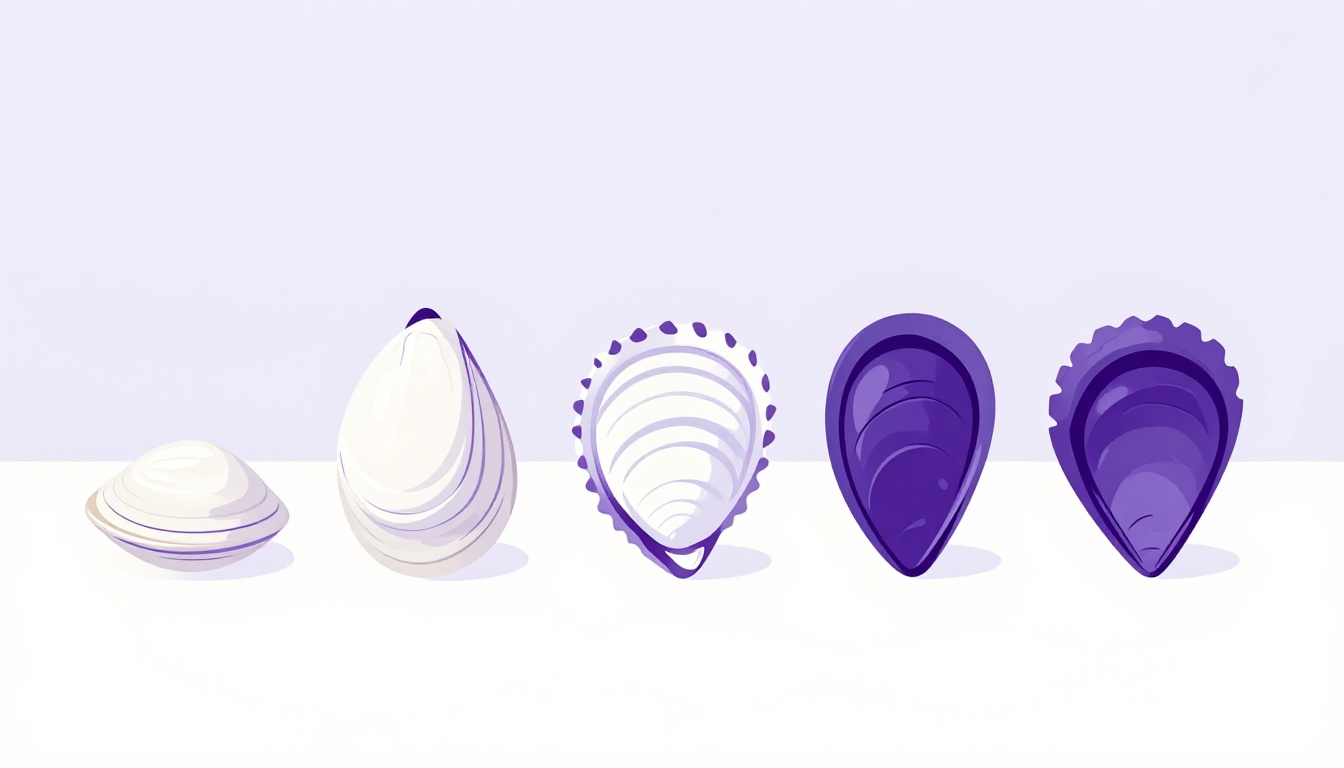
For more names in the same family, the Wiktionary entries for ostra (oyster), vieira (scallop), camarão (shrimp), lagosta (lobster), caranguejo (crab), lula (squid) and polvo (octopus) are worth a look. And if you want a bigger lens on the whole animal group, Wikipedia's Bivalvia article shows how clams, mussels, oysters and scallops are all cousins. Yes, all four are bivalves. English and Portuguese just draw the lines differently.
What Brazilians Call Clams: Vôngole, Sernambi and Berbigão
Now the big question for anybody heading to Brazil. Do Brazilians say "amêijoa"? They understand it, and the Brazilian Dicio entry covers it. But on a Brazilian menu you're more likely to see other names, and that's the part most English guides skip.
The Portuguese-language Wikipedia article on Sernambi explains why. Several species of small clams share the name "sernambi," and they're also called "berbigão," "papa-fumo," "vôngole," "amêijoa-branca," and "lambreta." People eat them fresh, dried, salted or smoked, especially in the Northeast. The article says the name comes from Tupi "serinambi," which it translates as "ear of siri," where "siri" is a kind of crab. If you like word origins, Wikipedia's page on the Tupi language tells the bigger story of Tupi words in Brazilian Portuguese.
Then there's "vôngole." That's a borrowed word. It comes from the Italian "vongole," the clams in the famous pasta dish, and the Dicio entry for "vongole" records it. The English-language Wikipedia page on spaghetti alle vongole explains the Italian original. In Brazil, "vôngole" is what you'll see on menus for Italian-style clam dishes. Chef Paola Carosella's espaguete ao vongole recipe and the Prática BR recipe for classic espaguete ao vôngole are two Brazilian Portuguese examples that show how the dish is written up at home.
The berbigão matters on the south coast too. The Bom Gourmet article about berbigão on the coast of Santa Catarina covers this small mollusc, and the title of the piece says it's popular on that coast and at risk of extinction. For an idea of the kind of small clam the Brazilian coast has, see Wikipedia's article on Anomalocardia flexuosa. Common names differ so much from region to region that scientists use Latin names for a reason.

So here's the practical rule. On a Brazilian menu, look for "vôngole" or "berbigão." In Portugal, look for "amêijoas." If you're not sure, point at the plate and ask "O que é isso?" ("What is that?").
| Portugal | Brazil | |
|---|---|---|
| Everyday word for clams | amêijoas | Often vôngole, berbigão or sernambi, depending on region |
| Clam pasta on a menu | massa ou esparguete com amêijoas | espaguete ao vôngole |
| Small local clam | amêijoa-boa, conquilha | sernambi, berbigão, lambreta |
| Word for the umbrella category | marisco | marisco |
| Where you'll hear the Italian word | Not the usual word | Common, from Italian "vongole" |
| Spelling of the pasta | esparguete | espaguete |
Two more points. First, Wikipedia's page on Brazilian Portuguese and its page on European Portuguese explain how the two varieties drifted apart, and food words are one of the areas where they clearly did. Second, if you're building a bigger food vocabulary for Brazil, food in Portuguese is the right next stop, and Wikipedia's Brazilian cuisine article shows how regional it is. A dish like moqueca, the seafood stew, tells you how much of the coast ends up in Brazilian pots.
Classic Portuguese Clam Dishes You Should Know by Name
Vocabulary sticks when it's attached to something you can eat. So here are the dishes, with the names you'll see on menus. Wikipedia's overview of Portuguese cuisine is a decent map if you'd like the wider picture.
Amêijoas à Bulhão Pato
This is the one. It's the clam dish most people mean when they say "Portuguese clams." Fresh clams, olive oil, plenty of garlic, chopped fresh coriander, and a squeeze of lemon or a splash of white wine. Served with bread to mop up the sauce. That's it. No cream, no pasta, nothing fancy.
The name comes from the poet Raimundo António de Bulhão Pato. Wikipedia's article on the dish says it's a Lisbon dish that appeared in the 1850s. It also says the poet most likely didn't create it, and that the chef João da Mata is often credited, though that's contested. So the name is a bit of a mystery, like the origin of the word "amêijoa" itself.
In Portuguese the pattern is "à" plus a name, meaning "in the style of." You'll see it on other menus too, like "à Brás" and "à Lagareiro." A dish like this usually lands on the table as a "petisco," a small shared plate, which is also a word you can look up in the Wiktionary entry for "petisco".
If you want to cook it, the Visit Portugal recipe for amêijoas à Bulhão Pato lists clams, garlic, lemon, coriander, salt, pepper and olive oil. Plenty of other cooks have written their own versions, and it's fun to compare them. Leite's Culinaria pairs the dish with vinho verde, Culinary Backstreets tells the Lisbon story, and 196 flavors has a step-by-step version. You'll find more takes at Food From Portugal, Gastro Portugal, The Kitchn, Stefan's Gourmet, and Taste of Lisboa.
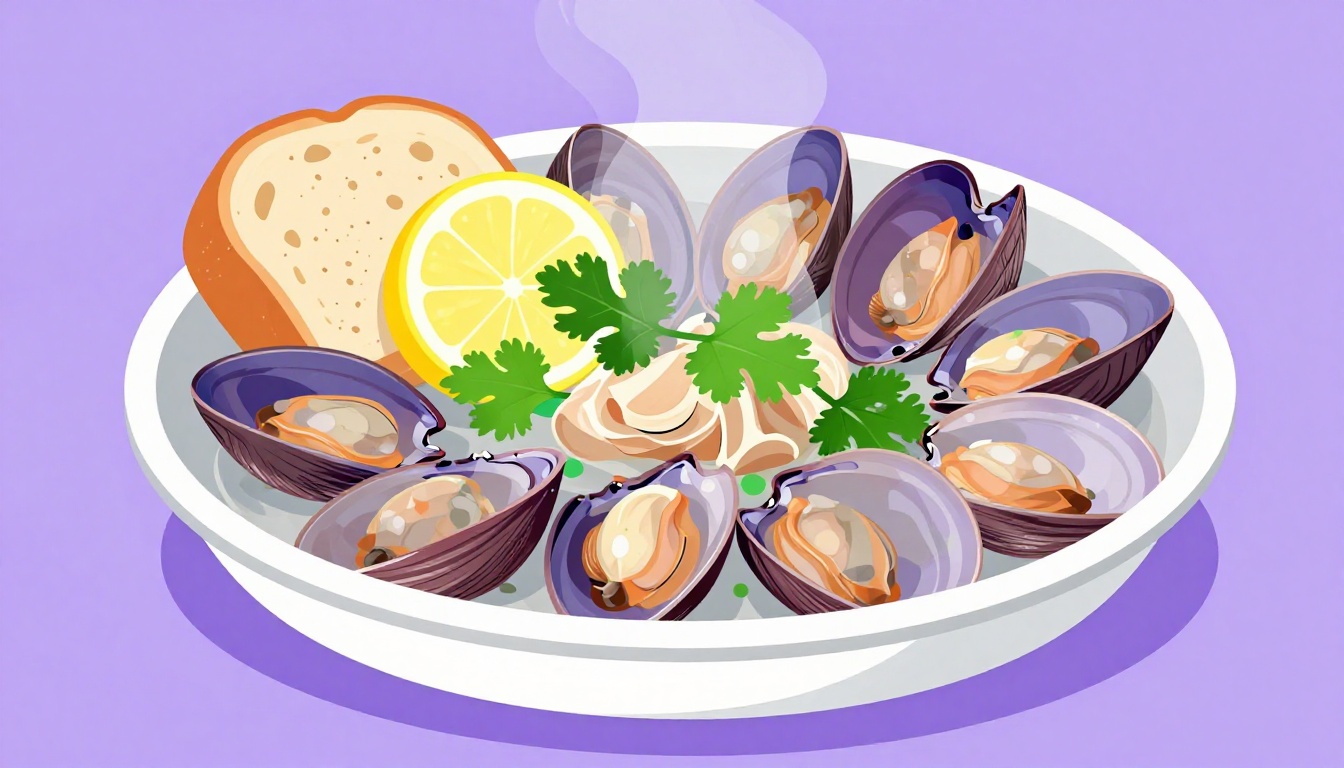
The wine side has its own words. If you want to name what's in your glass, wine in Portuguese covers the vocabulary, and Wikipedia's Vinho Verde article explains the light, fresh wine from the north that recipe writers love with clams. And you'll need the word for the thing you mop the sauce with. That's "pão," and bread in Portuguese gets into it.
Amêijoas na cataplana
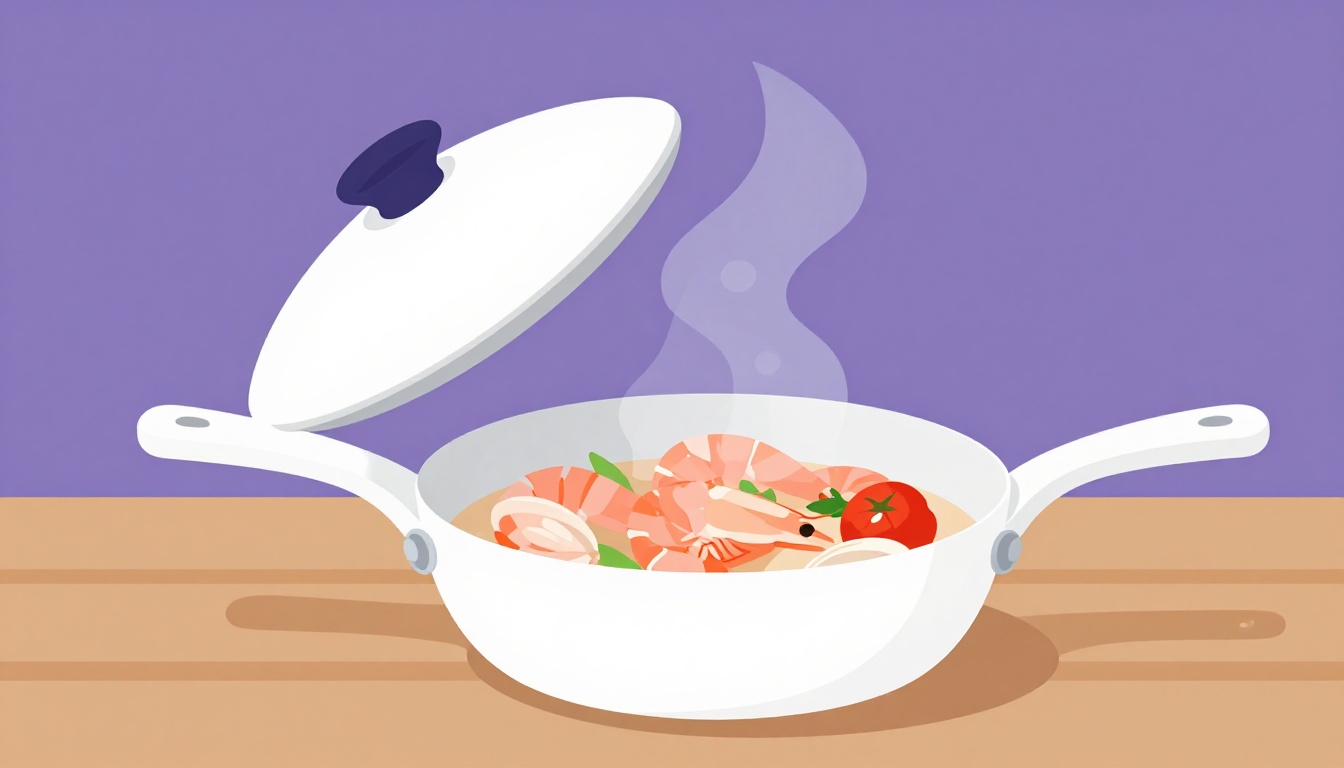
Head south to the Algarve, and the star is a pot. A cataplana is a hinged copper cooking vessel that looks like two clamshells joined together. You close it with clamps, and it works like a crude pressure cooker. Steam builds up inside and cooks everything fast, in its own juices.
Wikipedia's Cataplana page says historians link it to the tagine, and that the Oxford Companion to Food calls clams in the cataplana the most famous cataplana dish. Typical layers include clams, prawns, fish, and sometimes sausage, with tomato, peppers, garlic and coriander. Catavino's article on cooking in a cataplana explains how the pot works, and Leite's Culinaria has a cataplana recipe with clams and sausage if you want to try it. For the region itself, Wikipedia's Algarve article and its page on the Ria Formosa lagoon give you the geography, and the Ria Formosa is where the "lingueirão" lives, according to Amass Cook.
Arroz de marisco and arroz de amêijoas
Rice with shellfish is a Portuguese comfort dish. "Arroz de marisco" is the broad version, and it can contain clams, mussels, prawns and more. "Arroz de amêijoas" narrows it down to clams. Wikipedia's Arroz de marisco page gives the background, and Gastro Portugal's arroz de marisco page shows a recipe. Note the "de." It's rice "of" seafood.
Carne de porco à alentejana
This one surprises English speakers. It's pork and clams in the same dish. Amass Cook mentions that the "amêijoa-boa" is used in it, and Wikipedia's page on carne de porco à alentejana describes the dish. The name points to the Alentejo region, known for its farmland, so land and sea meet on the plate.
Arroz de lingueirão, arroz de berbigão and xerém de berbigão
The razor clam gets its own rice. We Travel Portugal's page on arroz de lingueirão shows it. The cockle also has its dishes: per Amass Cook, "arroz de berbigão" (cockle rice) and "xerém de berbigão." Xerém is a thick cornmeal dish, and it's a nice case of a common ingredient and a small shell on the same plate.
Espaguete ao vôngole in Brazil
Brazil's clam dish is Italian at heart. You'll see it as "espaguete ao vôngole," or "spaghetti with clams." The recipes we linked above show it. It's a very different meal from Bulhão Pato, so knowing both names keeps you from ordering the wrong thing.
Here's the summary in one place.
| Dish | English | One-line description |
|---|---|---|
| amêijoas à Bulhão Pato | clams Bulhão Pato style | Clams with olive oil, garlic, coriander and lemon |
| amêijoas na cataplana | clams in the cataplana | Algarve dish, steamed in a hinged copper pot |
| arroz de marisco | seafood rice | Rice cooked with mixed shellfish |
| arroz de amêijoas | clam rice | Same idea, with clams only |
| carne de porco à alentejana | Alentejo-style pork | Pork and clams together |
| arroz de lingueirão | razor clam rice | Rice with razor clams |
| arroz de berbigão | cockle rice | Rice with cockles |
| xerém de berbigão | cockles with xerém | Thick cornmeal dish with cockles |
| espaguete ao vôngole | spaghetti with clams | Brazil's Italian-style clam pasta |
Reading a list of dish names is one thing. Saying them so a waiter understands you is another. If the "à Bulhão Pato" part makes your tongue trip, you can say each of these names out loud with Comigo before you sit down at the table, because your mouth needs the reps as much as your eyes do.
Buying and Cooking Clams: The Words You Need
Say you skip the restaurant and buy clams yourself. Good idea. A market in Portugal or a fish stall in coastal Brazil is a great place to hear real Portuguese, and the vendors talk about clams all day. You just need the kitchen words.
| Portuguese | English | Pronunciation hint |
|---|---|---|
| lavar | to wash | lah-VAR |
| deixar de molho | to soak (literally "to leave in sauce") | DAY-shar jee MOH-lyoo |
| água com sal | salted water | AH-gwah kom SAHL |
| areia | sand | ah-RAY-ah |
| escorrer | to drain | esh-koh-HEHR (Brazil) |
| abrir | to open | ah-BREER |
| fechada | closed (feminine) | fay-SHAH-dah |
| aberta | open (feminine) | ah-BEHR-tah |
| fresco / fresca | fresh | FRESH-koo / FRESH-kah |
| um quilo | a kilo | oom KEE-loo |
| meio quilo | half a kilo | MAY-oo KEE-loo |
| panela | pot | pah-NEH-lah |
| frigideira | frying pan | free-zhee-DAY-rah (Brazil) |
| azeite | olive oil | ah-ZAY-chee (Brazil) |
| alho | garlic | AH-lyoo |
| coentros | coriander (cilantro) | koh-EN-troosh (Portugal) |
| limão | lemon or lime | lee-MOWNG |
| sal | salt | SAHL |
| pimenta | pepper | pee-MEN-tah |
Some of these have a good page in Wiktionary if you want to hear them or see the forms: areia, alho, coentro, azeite, and concha. The word "areia" is the most useful of them. It's the enemy of any clam recipe.
Clams live buried in sand, and a gritty clam ruins dinner. So recipe writers tell you to soak them first. 196 flavors says to soak them in salted water for two to three hours, while other sources give one to two hours. So the real answer is one to three hours, depending on the recipe. You rinse them, you let them sit, and the clams spit out sand into the water.
The other rule is about opening. A clam that stays closed after cooking should be thrown away, say recipe writers such as Leite's Culinaria and Caroline's Cooking. In Portuguese: "Se a amêijoa não abrir, deita-se fora." It sounds harsh, but everyone agrees on it.

Now the fishmonger phrases. These are the sentences you'll actually say at the stall.
| Portuguese | English |
|---|---|
| Bom dia. Queria amêijoas, por favor. | Good morning. I'd like clams, please. |
| Quero meio quilo de amêijoas, por favor. | I want half a kilo of clams, please. |
| Estas amêijoas estão frescas? | Are these clams fresh? |
| São de hoje? | Are they from today? |
| Tem berbigão? | Do you have cockles? |
| Quanto custa o quilo? | How much is a kilo? |
| Pode pôr um pouco de gelo? | Could you add a little ice? |
| É tudo, obrigado. | That's all, thank you. |
You'll need numbers at the stall, so numbers in Portuguese is worth a quick pass. You'll need the politeness word too, and please in Portuguese explains why "por favor" and "faz favor" both show up. "Obrigado" is the thank-you word for a man, and "obrigada" is for a woman. Say it with a smile.
If the clams need a soak, you'll be reaching for the tap. Water in Portuguese has the vocabulary you need around the sink and the bottle.
Ordering Clams at a Restaurant in Portugal or Brazil
Ordering is where the fear lives. Nobody's watching your accent at a market stall, but at a table with a waiter waiting, you feel it. So let's rehearse.
Here's a simple exchange for a restaurant in Portugal. Read both sides out loud, and then read only your side.
| Who | Portuguese | English |
|---|---|---|
| Waiter | Boa noite. Já escolheram? | Good evening. Have you chosen? |
| You | Sim. Queremos amêijoas à Bulhão Pato, por favor. | Yes. We'd like clams Bulhão Pato style, please. |
| Waiter | É uma dose ou meia dose? | Is that a full or half portion? |
| You | Uma dose, para partilhar. | A full portion, to share. |
| Waiter | Querem pão? | Would you like bread? |
| You | Sim, com pão, por favor. | Yes, with bread, please. |
| You | Podem fazer sem coentros? | Can you make it without coriander? |
| Waiter | Claro. E para beber? | Of course. And to drink? |
| You | Uma água e um vinho verde, por favor. | A water and a vinho verde, please. |
Now some menu words. Restaurants in Portugal often split the menu in ways that confuse visitors.
| Menu word | English | Notes |
|---|---|---|
| entradas | starters | Often bread, olives, cheese, and small shellfish |
| petiscos | small plates to share | Clams often appear here |
| prato do dia | dish of the day | Ask what it is |
| dose | full portion | Usually meant to share |
| meia dose | half portion | Good if you're alone |
| com pão | with bread | Ideal for the sauce |
| sem coentros | without coriander | Useful if you dislike it |
| frutos do mar | seafood | The menu category |
| marisco | shellfish | Can include clams, mussels, prawns |
| a conta | the bill | "A conta, por favor" |
If you want a bigger menu vocabulary, food in Portuguese is the general guide. For a drink to go with clams, the word for beer is "cerveja," and beer in Portuguese covers how to order one. For the seafood category in general, the Linguee page for "seafood" and Wikipedia's Seafood article help you see how broad the term is in English too.
Some more phrases for the table:
| Situation | Portuguese | English |
|---|---|---|
| Getting attention | Com licença, pode ajudar-me? | Excuse me, can you help me? |
| Asking what it is | O que é isto? | What is this? |
| Asking for a recommendation | O que recomenda? | What do you recommend? |
| Ordering | Para mim, as amêijoas, por favor. | For me, the clams, please. |
| More bread | Pode trazer mais pão? | Could you bring more bread? |
| Language help | Não falo bem português. | I don't speak Portuguese well. |
| Checking | Isto tem marisco? | Does this have shellfish? |
If you get stuck, you're not the first, and I don't speak Portuguese in Portuguese gives you the calm phrase to keep the conversation going.
Ordering in Brazil
Brazilian restaurants speak a little differently, and the menu might say "vôngole" or "berbigão" instead of "amêijoas." The tone is often warmer and looser, and the waiter may call you "você" right away. Here's a short exchange you can adapt.
| Who | Portuguese | English |
|---|---|---|
| Waiter | Oi, tudo bem? Já sabem o que vão pedir? | Hi, how are you? Do you know what you'll order? |
| You | Vocês têm berbigão hoje? | Do you have cockles today? |
| Waiter | Temos, sim. Também temos espaguete ao vôngole. | Yes, we do. We also have spaghetti with clams. |
| You | Vou querer o espaguete ao vôngole, por favor. | I'll have the spaghetti with clams, please. |
| Waiter | Vai querer alguma bebida? | Would you like something to drink? |
| You | Uma cerveja gelada, por favor. | A cold beer, please. |
And here's how to talk about the taste once the plate arrives. You'll want more than "good."
| Portuguese | English | Notes |
|---|---|---|
| gostoso | tasty | Very common in Brazil |
| saboroso | flavorful | Works in both countries |
| salgado | salty | Clams taste of the sea, so this is normal |
| fresco | fresh | Also the word for a fresh clam |
| picante | spicy | Ask before adding chili |
| Está uma delícia! | It's delicious! | A warm thing to say to the cook |
Saying "Está uma delícia!" to a waiter or a host is one of the fastest ways to make someone smile. Practice it, because compliments in a new language feel good on both sides of the table.
Allergies: a short, serious note
If you have a shellfish allergy, this part matters more than the poetry of the dish. The two key phrases are "Tenho alergia a mariscos" ("I'm allergic to shellfish") and "Isto tem marisco?" ("Does this have shellfish?"). Say them slowly. If you're a man, you can also say "Sou alérgico a mariscos," and a woman says "Sou alérgica a mariscos."
This is a language aid, not medical advice. A phrase won't protect you from everything. Seafood kitchens use shared pots, oils and surfaces, and cross-contamination is a real concern. Wikipedia's Shellfish allergy article and FARE's page on shellfish allergy explain the basics. Also note that "marisco" is a wide category, and the Linguee page for "shellfish" shows how translators handle it. If it's serious, talk to your doctor before you travel, and don't rely only on a phrase.
A Word of Caution: Amêijoa Is Also Slang in Portugal
You should know one more thing. The Priberam entry for "amêijoa" lists a second sense for Portugal, marked as a vulgar term (a "tabuísmo") for female genitalia. That's all we'll say about it.
What this means in practice is simple. In Portugal, don't use "amêijoa" as a figure of speech or a compliment, and expect the occasional smirk if you say it in a joking tone. Ordering clams at a restaurant is perfectly normal. Nobody will bat an eye when you say "Quero amêijoas, por favor." Context does the work, and a waiter knows exactly what you mean.
If you'd like to know more about the words that carry a double meaning, bad words in Portuguese explains how to spot them before they surprise you.
English Clam Expressions in Portuguese
English is full of clam idioms, and they don't travel well. Portuguese doesn't have the same picture in its head, so a word for word translation would just sound odd.
| English | Portuguese | Notes |
|---|---|---|
| to clam up | calar-se / ficar calado | Means going suddenly silent. See Linguee for "clam up" |
| to close up, withdraw | fechar-se em copas | A different idiom with a similar feeling |
| happy as a clam | feliz da vida | See Linguee for "happy as a clam" |
| clam chowder | sopa de amêijoas / sopa de mariscos | No exact Portuguese twin |
| to dig for clams | apanhar amêijoas | "Apanhar" means to pick up or gather |
Take "clam up." In English, the shell closes, and the person stops talking. In Portuguese you say "calar-se," which just means to fall silent, with no shell. The picture is lost, but the meaning stays. "Feliz da vida" means "happy about life," and it does the job of "happy as a clam" without any animal.
Clam chowder is a special case. It's a thick soup from North America, and Wikipedia's Clam chowder article explains the history. You won't usually find an exact twin in a Portuguese restaurant. The closest match is "sopa de amêijoas" or "sopa de mariscos." If you ask for it in Portugal, expect a different soup than the New England one.
Idioms in general are one of the hardest parts of any language. Common sayings in Portuguese has a good set of them, and the rule is always the same: learn the whole phrase, don't translate it piece by piece.

Feeling happy about a bowl of clams is the right mood to bring to the table. Capy would approve.
How to Practice Saying Amêijoas Out Loud
Reading about a sound doesn't teach your mouth. You need reps. Here's a plan that takes ten minutes.
Drill 1: The plum trap
There's a lookalike word. "Ameixa" means plum. It's a real Portuguese word, and it's the perfect trap for a learner. Notice that the Galician cousin of "amêijoa" is also "ameixa," so the resemblance isn't an accident. But in Portuguese, they're separate words.
| Word | Meaning | Sound | The difference |
|---|---|---|---|
| amêijoa | clam | ah-MAY-zhwah | ends in the "zh" sound |
| ameixa | plum | ah-MAY-shah | the "x" sounds like "sh" |
Say them one after the other. "Amêijoa, ameixa. Amêijoa, ameixa." The "zh" buzzes in your throat, and the "sh" is just air. Put a hand on your neck. If it buzzes, you said clam. If it doesn't, you said plum.
Drill 2: Words with the same glide
The "ei" plus "j" sound shows up in other common words. Practice them as a family.
| Word | Meaning | Rough sound |
|---|---|---|
| queijo | cheese | KAY-zhoo |
| beijo | kiss | BAY-zhoo |
| feijão | beans | fay-ZHOWNG |
| amêijoa | clam | ah-MAY-zhwah |
Say all four in a row, and your mouth learns the pattern.
Drill 3: Shadowing
Find a video of a Portuguese cook making clams. Play one sentence, pause it, and repeat it right away, copying the speed, tone and stress. Don't worry about being perfect. The point is rhythm.
Drill 4: Record yourself
Record yourself on your phone saying "Quero uma dose de amêijoas, por favor." Play it back. Compare it to the video. You'll hear the gap, and that gap is your homework.
Drill 5: The ten-second restaurant script
Learn this by heart until you can say it without looking. Ten seconds. No pauses.
Boa noite. Uma mesa para duas pessoas, por favor. Quero uma dose de amêijoas à Bulhão Pato e um pouco de pão. Obrigado!
If you're a woman, finish with "Obrigada." Say it in the shower, on the bus, or to the cat. Out loud. A spoken sentence you've said twenty times is a sentence you can say at a table.
Common Mistakes English Speakers Make
You'll probably make a few of these. That's fine. Here's the list so you can catch them early.
| Mistake | Why it happens | Fix |
|---|---|---|
| Saying "mexilhão" for clam | Some dictionary pages list it first | "Mexilhão" is a mussel. Clam is "amêijoa" |
| Dropping the ê accent | Phone keyboards make it hard | Write "amêijoa" with the circumflex |
| Saying "j" like the "j" in "jam" | English habit | It's the "s" in "measure" |
| Saying "o amêijoa" | English has no gender | It's "a amêijoa," feminine |
| Using "amêijoa" as a metaphor in Portugal | It sounds cute to an English ear | Avoid it, because of the slang meaning |
| Calling every shellfish "marisco" | It seems like the easy word | "Marisco" is the umbrella. Use "amêijoa" for clams |
| Forgetting plural agreement | English adjectives don't change | "Amêijoas frescas," not "amêijoas fresco" |
| Mixing up amêijoa and ameixa | They look alike | Clam has "zh," plum has "sh" |
Frequently Asked Questions
How do you say clam in Portuguese?
The word is "amêijoa," and the plural is "amêijoas." It's feminine, so you say "a amêijoa" for the clam. In Brazil, some small clams also go by "vôngole," "berbigão" or "sernambi."
Is it amêijoa or ameijoa?
The correct spelling is "amêijoa," with a circumflex on the "ê." People often type "ameijoa" without the accent, especially in searches, and it's usually understood. But when you write it properly, use the accent.
What is the difference between amêijoa and berbigão?
A "berbigão" is a cockle, and an "amêijoa" is a clam. They're close cousins, and both are bivalves, but they're different animals with different shells. Many recipes let you swap one for the other in a pinch.
What do Brazilians call clams?
Brazilians understand "amêijoa," but on menus and in markets you'll often see "vôngole," "berbigão," "sernambi" and other regional names. "Vôngole" comes from the Italian "vongole" and is common in pasta dishes.
What are clams with garlic and coriander called?
They're called "amêijoas à Bulhão Pato." It's a famous dish from Lisbon made with olive oil, garlic, fresh coriander, and lemon or white wine. It's usually served with bread.
Is mexilhão the same as a clam?
No. A "mexilhão" is a mussel. Some dictionary pages list it near the top for clams, but the animal is different, and the Portuguese names are different too.
How do you say "I'm allergic to shellfish"?
You say "Tenho alergia a mariscos." You can also say "Sou alérgico a mariscos" if you're a man, and "Sou alérgica a mariscos" if you're a woman. This is a language aid, not medical advice.
How do you pronounce amêijoas?
In Brazil it's roughly "ah-MAY-zhwahs." In Portugal the vowels are squeezed more. The "j" sounds like the "s" in "measure," and the "ê" carries the stress.
What is a cataplana?
A cataplana is a hinged copper cooking pot that looks like two clamshells joined together. It's sealed with clamps and works like a crude pressure cooker. It comes from the Algarve, and clams are one of its best-known dishes.
What does "amêijoa" mean as slang?
In Portugal, the word has a second, vulgar meaning for female genitalia, according to Priberam. So avoid using it as a figure of speech. Ordering clams at a restaurant is perfectly normal.
Say It Out Loud, Then Order It
You now know more about one small shell than most waiters expect a tourist to know. You've got the word, the accent, the gender, the plural, the difference between clams, cockles and mussels, the dishes, and the phrases for the market and the table. Not bad for one word.
But knowing isn't saying. The gap between the two is where most learners freeze, and it closes only one way: with your voice. So take the ten-second script from this page, say it out loud today, and if you'd like a place where a friendly capybara listens and shows you which words landed, you can start speaking with Comigo. Then, next time a waiter in Lisbon says "amêijoas," you smile and say "Sim, por favor."
If you're still deciding whether the language is worth the effort, is Portuguese hard to learn gives you an honest answer, and if you're planning a trip, Lisbon is a good place to eat your first plate.
Related guides
- italki reviewAn honest italki review: how lessons work, tutor quality, pricing and the downsides.
- Is Rosetta Stone worth it?Is Rosetta Stone worth the money in 2026? What it does well, and where it falls short.
- How much does Rosetta Stone cost?Rosetta Stone pricing explained: plans, lifetime deals and what you actually get.
- BoldVoice vs ELSA SpeakBoldVoice vs ELSA Speak: accent coaching, feedback quality, price and which to pick.